

Work, Life & Wealth: The Engineer's Time Arbitrage

Paradigm-Shifting Insight Introduction:
Most engineers, driven by their analytical prowess, believe in optimizing every minute of their day. They meticulously plan their work, social life, and even leisure, often leaving investment decisions as a reactive task. This is a fundamental miscalculation. The traditional understanding posits that “time is money,” leading to a relentless pursuit of maximizing billable hours or productivity metrics. However, for long-term wealth creation, a far more powerful principle applies: “Time is leverage.”
The conventional wisdom misses a crucial arbitrage opportunity unique to the engineer’s disciplined mind: the ability to front-load investment decision-making through systematic frameworks, thereby freeing up vast swathes of future time for growth, compounding, and deeper professional pursuits. This isn’t about finding more minutes in the day; it’s about making those minutes exponentially more effective by applying engineering principles to personal finance, transforming it from a chore into an automated engine of wealth. The engineers who achieve generational wealth are not those who spend the most time on their investments, but those who spend the most time designing their investment system.
Youtube Link:
Advanced Analytical Framework: The “Flow-State Investment Protocol” (FSIP)
The core of FSIP lies in minimizing cognitive load during the execution phase of investing by maximizing it during the design phase. We aim for “flow-state” investing, where actions are almost automatic, guided by pre-defined parameters.
Proprietary Screening Criteria: The “10-Hour Rule” for Due Diligence
Instead of chasing daily market noise, engineers should allocate a maximum of 10 dedicated, uninterrupted hours per quarter to macro-level research and portfolio recalibration. This is your “engineering design sprint” for wealth. During this period, you apply a strict 3-tiered filter:
Macro-Economic Headwinds/Tailwinds (2 hours): Analyze the top 3 global and Indian macro factors impacting equities (e.g., interest rate cycles, commodity supercycles, government policy shifts). Focus on structural shifts, not fleeting news.
Sectoral Rotation Opportunities (4 hours): Identify 2-3 high-conviction sectors poised for outperformance in the next 12-18 months based on industry trends, technological disruption, and competitive moats. Utilize your engineering domain expertise here – you understand technological shifts better than most generalist analysts.
Core Portfolio Health Check (4 hours): Review your existing holdings against the updated macro and sectoral outlook. Are they still aligned with your long-term thesis? Is there a better allocation?
Calculation Method: The “Compounding Coefficient of Cognitive Automation (C³)”:
C³ = (Time Saved Annually from Automated Decisions / Total Time Spent on Investing) * Portfolio Growth Rate
This metric quantifies the efficiency of your investment system. A higher C³ indicates that your upfront design effort is generating significant future time savings and portfolio growth. The goal is to maximize C³ by setting up automated investment vehicles (SIPs, index funds, rebalancing rules) that run in the background.
Visual Knowledge Synthesis:
Here’s a proprietary diagram illustrating the “Flow-State Investment Protocol” (FSIP) and its impact on time and wealth.
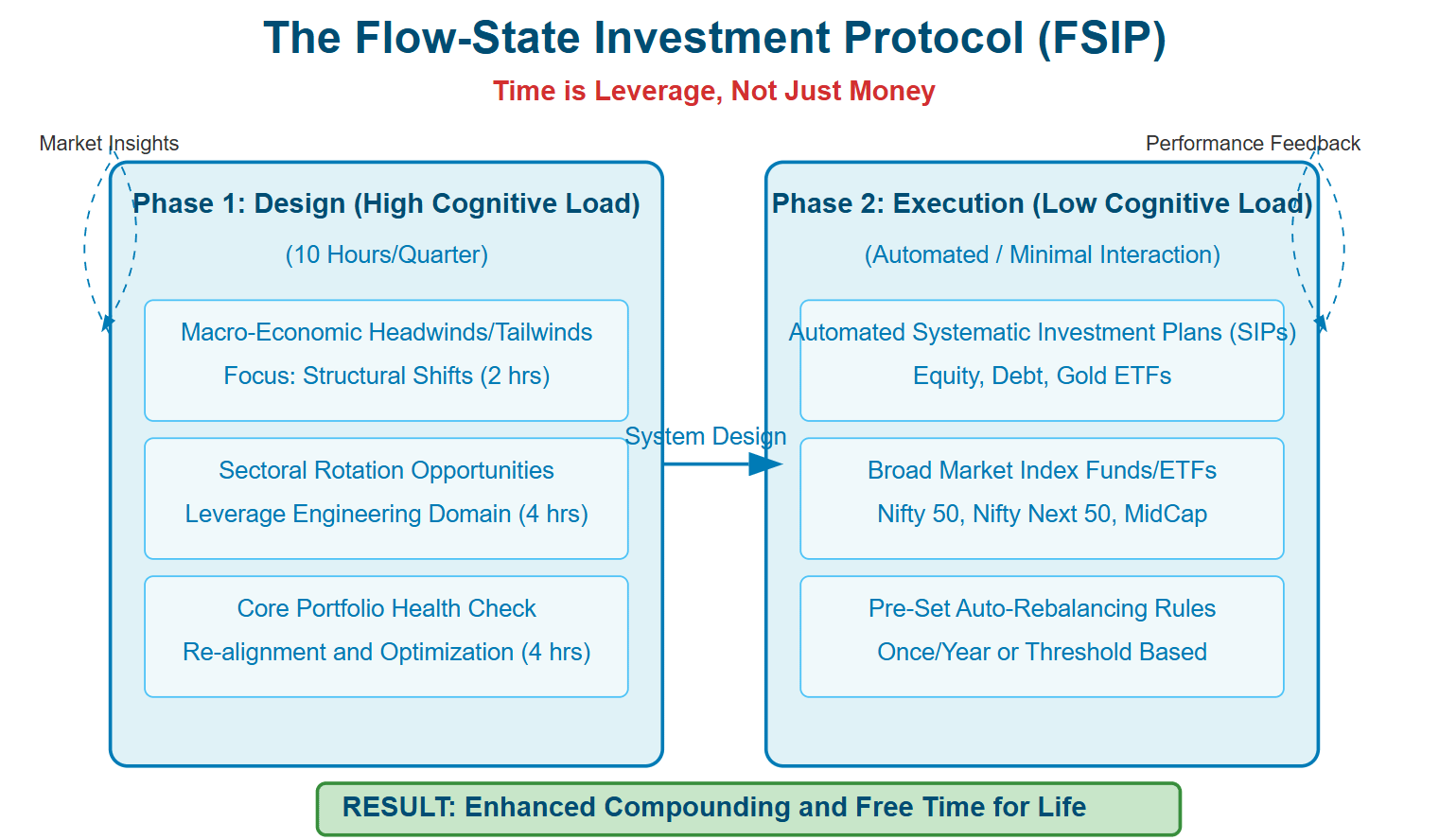
The diagram illustrates how a focused, high-cognitive-load “Design Phase” (10 hours/quarter) directly feeds into a low-cognitive-load “Execution Phase” through automated systems. This minimizes daily effort, leading to enhanced compounding and freeing up time. The dashed arrows represent continuous feedback loops – market insights influencing design and performance feeding back for recalibration.
Elite-Level Application Examples:
Case Study 1: The “Lazy Engineer’s” Triumph (Successful)
Dr. Rohan Mehta, a lead R&D engineer at a Bangalore-based semiconductor firm, adopted FSIP two decades ago. Instead of day trading or reading endless news, he spent his 10 quarterly hours establishing a core portfolio of Nifty 50 and Nifty Next 50 index funds via SIPs. Additionally, using his industry foresight, he identified the burgeoning IT services sector in the late 90s and allocated a small, fixed percentage to a well-managed IT sector fund. His rule was simple: “Set it and forget it, until the next quarterly review.” His rigorous professional life left him no time for daily market vigilance, yet his portfolio outpaced many active traders precisely because of this structured disengagement. His C³ was exceptionally high, allowing him to focus on patenting new chip designs while his wealth silently compounded. He wasn’t doing more investing; he was thinking more effectively about it.
Case Study 2: The “Over-Optimizing Engineer’s” Pitfall (Unsuccessful)
Priya Sharma, a brilliant software architect, believed in “real-time optimization” for everything, including her investments. She spent hours daily tracking individual stocks, reading analyst reports, and attempting to time market entries and exits. While her intentions were good, the emotional drain and cognitive overload from constant decision-making led to suboptimal choices. She missed major upswings due to overthinking and suffered more significant losses during downturns by panic selling, all while sacrificing time with family and neglecting her own well-being. Her C³ was effectively negative because the time spent generated more stress and poorer returns than a systematic, automated approach. She confused “activity” with “productivity” in investing.
Implementation Strategy:
Calendar Block Your “Design Sprints”: Schedule your 10 quarterly hours like a critical project deadline. Treat it with the same respect as a meeting with a key client.
Automate Everything Feasible: Set up Systematic Investment Plans (SIPs) in diversified equity and debt mutual funds, or directly in index ETFs. Implement automatic rebalancing for your asset allocation (e.g., once a year, or when an asset class deviates by more than 10% from its target).
Define Your “Exit Criteria” Upfront: Just as you define success metrics for a project, pre-determine when you would reduce exposure to a sector or specific fund. This removes emotion from future decisions. For instance, “If sector X’s P/E multiple exceeds its 5-year average by 30%, I will trim 10%.”
Embrace the “Ignore-Most” Protocol: Filter out 95% of financial news. Focus only on the macro and structural shifts during your quarterly review. Avoid the urge to check your portfolio daily; you’ve designed a system for resilience, not daily thrills.
The “Reverse-Engineering Your Retirement” Technique: Work backward from your desired retirement corpus and lifestyle. Calculate the monthly investment required and automate it. Then, during your quarterly reviews, assess if your current trajectory aligns. This shifts the focus from “what to buy” to “what system do I need to build to reach my goal,” a perspective far more natural for an engineer.
By applying their inherent aptitude for system design and disciplined execution, engineers can transcend the typical investment struggles. They can arbitrage time, not by finding more of it, but by making their investment decisions once, intelligently, and then letting the system work for them, creating truly generational wealth with minimal ongoing effort.
This post really hit home. 👏
Beyond decision fatigue, there’s also the subtle but constant dopamine chase that daily market activity creates and that often clouds judgment more than we realize.
I especially liked the 3-tiered filter approach. The key, in my view, is disciplined, time-boxed research with a clearly defined scope - ideally driven by predefined prompts, because without structure, it’s very easy to drift.
An engineering mind, in particular, tends to slip into endless analytics unless there’s a clear stop rule.
Do you have a guideline or checklist for implementing the 3-tier approach effectively?
I’m keen to try this in my own process and will share my learnings here as I do.
Thank you for sharing this with us.