

The Premiumization Shift Reshaping India’s Everyday Consumption

Section I — Investment Thesis & Summary
Sometimes the most interesting stocks are the ones that have been absolutely punished by the market. This one is down nearly 40% from its 52-week high of ₹711. It’s trading close to its 52-week low of ₹361. And the last quarter showed a net loss.
So why are we even talking about it?
Because underneath the pain, there’s a consumer brand story that’s genuinely compelling — and the market may be pricing in permanent damage when the reality is a rough transition year.
The stock sits at ₹354. Our 15-18 month target is ₹500 — that’s roughly 41% upside from here. But this isn’t a comfortable buy. It’s a bet on management executing a turnaround while a credible India consumption story plays out over the medium term.
Section II — Business Model & Operations
This company makes products every Indian household uses. Ceiling fans that cool you down in April. Water heaters that get you through January. Mixer grinders in the kitchen. Room heaters, air coolers, irons, pressure cookers. If it plugs in or heats something in an Indian home, there’s a good chance this company makes it.
The brand portfolio is solid. The flagship brand has over 85 years of heritage. Then there’s the premium range under a well-known international kitchen and grooming brand it distributes in India, a well-known cookware brand, and a budget-friendly consumer electronics range. Four brands, multiple price points, covering premium to mass market.
Here’s what makes this story interesting right now. Until recently, the company was also doing large-scale Engineering, Procurement & Construction (EPC) contracts — think power distribution lines, street lighting projects for governments. That business is capital-heavy, low-margin, and unpredictable. Management has been strategically winding it down to focus purely on the consumer products business. That transition is painful in the short run. Revenue dips when EPC orders dry up. But if they execute it right, what’s left is a leaner, higher-margin consumer franchise.
On the new business front, there have been two significant moves in the last few months. First, the company officially launched a Switchgear range — this is a logical extension into a category where electricians and contractors are already buying their fans and lighting. Second — and this is a bigger signal — the company announced plans to enter the wire and cables business. This is a bold move into a high-demand category given India’s infrastructure boom. The investment isn’t finalized yet, but the intent is clear: expand the product universe while the brand is still strong.
There’s also a manufacturing plant in the works. A ₹300 crore capex proposal to build a domestic manufacturing facility is under board evaluation. This would reduce import dependency and improve margins over time.
Youtube Link:
Section III — Historical Financial Review
Let’s be honest about the numbers. They’re not pretty at first glance.
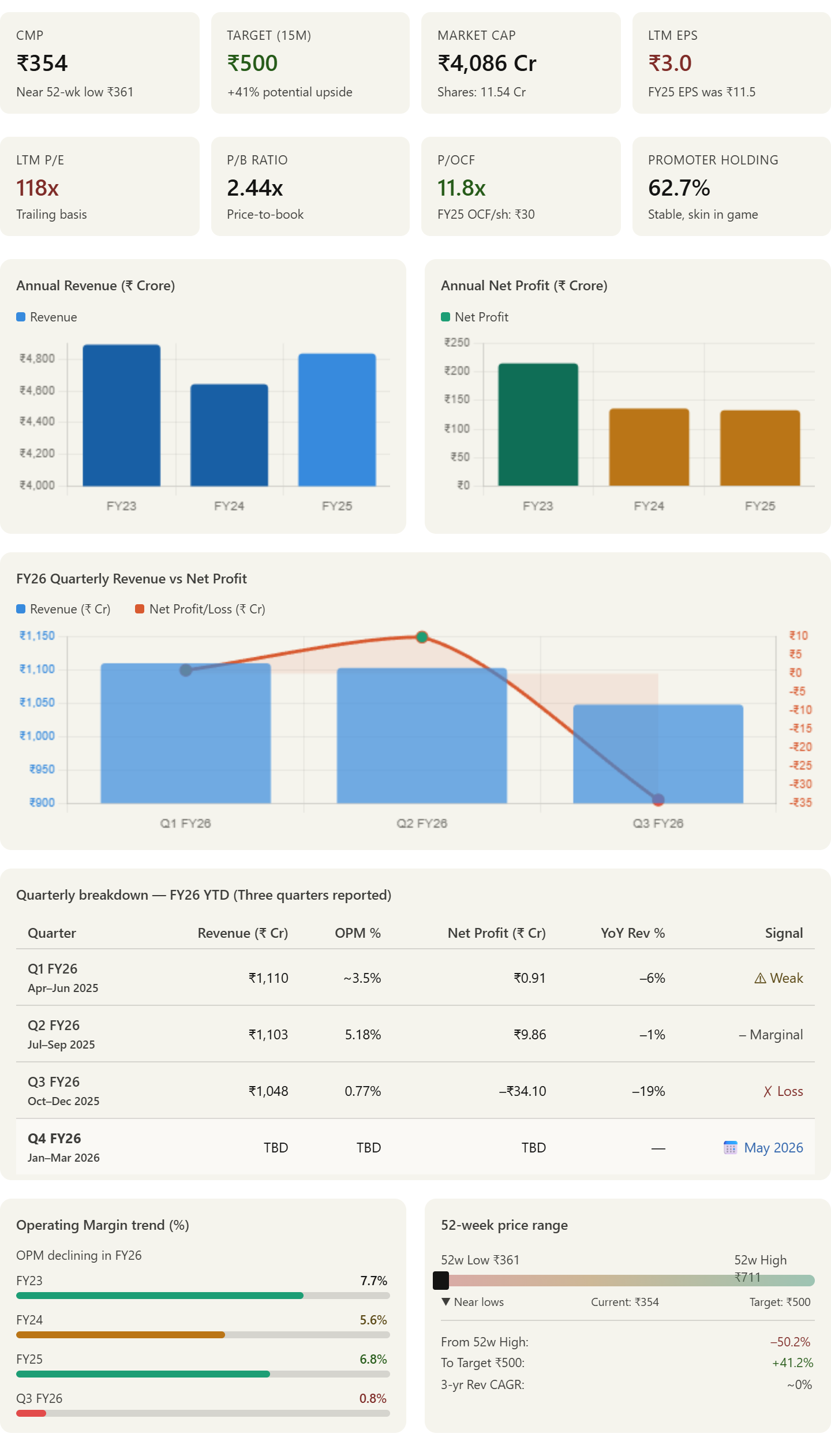
Revenue: The top line has been essentially flat for three years. From ₹4,892 crore in FY23, it dipped to ₹4,643 crore in FY24 — that’s a 5% fall, partly from EPC wind-down. FY25 recovered to ₹4,836 crore, up 4%. The 3-year revenue CAGR works out to less than 1% annually. For a consumer durables company in a growing India, that’s a significant underperformance.
Profitability: This is where the damage really shows. Net profit went from ₹215 crore in FY23 to ₹136 crore in FY24 (a 37% drop) and then barely held at ₹133 crore in FY25. The operating margin — what the company makes from its core operations before interest and taxes — slid from 7.7% in FY23 to 5.6% in FY24, then partially recovered to 6.8% in FY25. The direction in FY25 was promising. The execution since then, less so.
FY25 EPS (Diluted): ₹11.5 per share. That’s the number the market was using to anchor the stock at ₹700+ earlier this year. At that price, investors were paying about 60x earnings — expensive but justifiable if a strong growth story was unfolding. Since then, the story has gotten complicated.
Operating Cash Flow per Share (FY25): ₹30. This is actually a bright spot. Even though reported profits look thin, the company generated ₹347 crore in operating cash in FY25. At the current price of ₹354, you’re buying it at less than 12x operating cash flow. That’s not expensive for a branded consumer franchise. The gap between cash flow and reported profit exists because of heavy depreciation charges from recent capital investments.
3-Year Revenue CAGR: approximately flat (near 0%). Not the growth profile you want in consumer durables. But it’s worth understanding why — the EPC exit is masking the underlying consumer business growth. Strip out EPC, and the consumer segment has been growing meaningfully.
Section IV — FY26 Quarterly Performance — The Full Picture
This is where things got messy. The current fiscal year (FY26) has been rough, quarter after quarter.
Q1 FY26 (April–June 2025): Revenue came in at ₹1,110 crore — a 6% decline year-on-year. Net profit crashed to just ₹0.91 crore. For context, the same quarter last year delivered ₹28 crore in profit. The management cited lower consumer product sales and a one-time ex-gratia payment at their Nashik factory as reasons. A one-time hit, they said. The market didn’t buy it.
Q2 FY26 (July–September 2025): Some recovery happened. Revenue was ₹1,103 crore, roughly flat year-on-year. Profit came in at ₹9.86 crore — still down 24% versus last year, but at least it was positive. Operating margin improved to 5.18% from 4.63% in the same quarter last year. There was a glimmer of hope here.
Q3 FY26 (October–December 2025): This was the gut-punch. Revenue dropped 18.5% year-on-year to ₹1,048 crore. The company reported a net loss of ₹34.1 crore versus a profit of ₹33.4 crore in Q3 FY25. Operating margin collapsed to 0.77% — basically nothing. The stock unsurprisingly got hammered.
To make things more concerning, the company’s CFO and Key Managerial Personnel, who had been steering financials through the transition, submitted his resignation in October 2025 with effect from January 2026. An interim CFO was appointed in March 2026. Management transitions at critical junctures are always a yellow flag. They add uncertainty when the market is already nervous.
Last 12-Month (LTM) EPS: approximately ₹3. This captures the trailing four quarters from Q4 FY25 through Q3 FY26. At a stock price of ₹354, that implies a trailing P/E of roughly 118x. Let’s call it what it is — on a trailing basis, this stock is eye-wateringly expensive. The only way this investment makes sense is if earnings recover sharply in the quarters ahead.
The FY26 revenue run rate of approximately ₹4,260 crore annualized (based on 9-month revenue of ₹3,260 crore) is tracking below FY25’s ₹4,836 crore. This is not a growth story right now. It’s a recovery story.
Section V — Growth Potential
Here’s the bull case, and it’s not unreasonable.
India’s consumer durables market is one of the most structurally attractive in the world. Rising incomes, urbanization, easier credit, and replacement demand are all tailwinds that don’t go away. With a penetration of ACs, dishwashers, and premium fans still relatively low compared to peer economies, the decade-long runway for growth is real.
This company’s consumer business — fans, appliances, lighting — is exactly where you want to be. And with a portfolio spanning mass to premium across four brands, they can capture demand at multiple price points.
The switchgear launch is smart. Electricians who already stock this company’s fans and lighting will now buy switchgear from the same distributor. The wire entry, if executed well, gives them a stake in the infrastructure build-out. India is spending aggressively on housing, solar installations, and industrial expansion — all of which eat wire.
The manufacturing plant, if approved, will reduce reliance on imports and give them better control over costs and supply chains. That’s a medium-term margin story.
One more number worth noting: promoter holding is 62.71% — the founder family has significant skin in the game and hasn’t been selling. That alignment matters.
Section VI — Risks
Simply put — several things could go wrong here.
Earnings visibility is low. Three consecutive quarters of deteriorating profit with a loss in Q3 FY26 doesn’t inspire confidence. If Q4 FY26 (January–March 2026) comes in weak too, the recovery thesis gets pushed further out.
Management transition. A CFO exit and interim appointment at a pivotal moment adds uncertainty. New leadership needs time to settle and build trust with the market.
Valuation risk. At 118x trailing earnings, there is essentially zero margin of safety if the recovery doesn’t materialize. Any further earnings disappointment could push the stock lower.
Sector competition is fierce. V-Guard, Orient Electric, Havells, and Crompton are all hungry for the same pie. Price competition in fans and appliances is brutal.
GST notices. There are pending GST demand orders of ₹11.2 crore for FY 2019-20 and ₹8.7 crore for FY 2022-23. The company plans legal challenges, but these add noise.
Execution risk on new categories. Entering wires and switchgear sounds good in an investor presentation. Actually building market share against established players like Polycab and Havells is a different challenge altogether.
Section VII — Valuation & Target Price
At ₹354, here’s what you’re paying for:
On an LTM basis, the P/E is ~118x — forget it, that’s not the right lens for a turnaround. Look at it this way instead.
The company generated ₹347 crore in operating cash in FY25. At ₹354 per share (market cap ~₹4,086 crore), the P/OCF is ~11.8x. For a branded consumer franchise with 85+ years of brand equity, that’s not unreasonable.
If the company recovers PAT to approximately ₹155–165 crore by FY27 — a scenario supported by cost discipline, the EPC exit completing, and consumer demand normalizing — the FY27 estimated EPS would be around ₹13.5–14.3. At a sector-appropriate multiple of 33–35x (justified by the consumer brand moat and India’s long-term consumer growth story), the fair value would be ₹445–500.
12-month target: ₹500 per share — approximately 41% upside from current levels.
This is a conditional target. It requires:
Q4 FY26 showing a clear return to profitability
Revenue stabilizing and recovering in FY27
No further management surprises
The stock could also test ₹300–320 levels if Q4 FY26 disappoints. This is not a one-way bet.
Section VIII — Verdict
The market has been brutal to this stock. A 39% one-year decline is a statement — the crowd is clearly worried. And the crowd isn’t wrong to be worried. The numbers in FY26 so far have been genuinely bad.
But near 52-week lows, with a credible brand portfolio, a long-term India consumer story intact, and a P/OCF under 12x, there’s value hiding beneath the short-term pain. The entry point matters a lot with turnaround stories, and ₹350–360 looks like a zone where the risk-reward becomes interesting for patient investors.
The single most important event coming up is the Q4 FY26 earnings release in May 2026. If that quarter shows a decisive return to profitability, the stock re-rates quickly. If it disappoints again, the thesis breaks.
For existing holders: Hold. The worst may be priced in at these levels. For new buyers: Watch and wait. Set a price alert near current levels and wait for Q4 FY26 results before committing capital.
