

A Leading Road Infrastructure Company in India

SECTION I: Investment Thesis & Summary
India’s largest toll-road operator is sitting at a 30% discount to its 52-week high, and the market is pricing in almost zero growth — despite toll revenues growing 23% last year alone. That’s a disconnect worth paying attention to.
The balance sheet is heavy, the construction business is sluggish, and earnings per share looks modest relative to the massive ₹94,000 crore asset base this company controls. But here’s what the pessimists are missing — this business increasingly runs itself. Toll collections are compounding every year, new projects are in the pipeline, and India’s highway ecosystem isn’t slowing down. If you’re patient and can look 5+ years out, there’s a real story here.
SECTION II: Business Model & Operations
This company makes money the old-fashioned, high-conviction way — it builds a highway, you pay every time you drive on it, and that repeats for 25-30 years. That’s the core of the Build-Operate-Transfer (BOT) model. You build it once, fund it with debt, and collect tolls to pay off that debt and generate returns. Once debt is repaid, the margins are spectacular.
The portfolio right now covers 36 BOT projects spanning 19,000+ lane kilometres across 13 states. More importantly, they dominate India’s Toll-Operate-Transfer (TOT) market — where the government hands over an existing operational highway to a private player for a concession fee. They hold approximately 38-42% of the entire TOT market in India. That’s a near-monopoly in a growing niche, and it’s not easy for a competitor to replicate overnight.
The revenue engine has two moving parts: the Operations & Maintenance (O&M) side — toll collection from operational highways, which is steady, recurring, and largely inflation-linked — and the EPC/Construction side, which builds new projects. The construction book has been under pressure (revenues fell ~18% in H1 FY26), but management has been deliberate about shifting the mix toward O&M. That’s actually a healthier long-term direction.
In the latest quarter (December 2025), toll revenues rose 15% year-on-year for January 2026 and new toll collection points went live on January 23, 2026. Two new TOT assets — TOT-17 and TOT-18 — were recently added, bringing the group’s TOT market share to 42% and adding ~₹1,000 crore in expected incremental annual toll revenue from FY27 onwards. The company now operates in 13 states, having entered Odisha and expanded its footprint in eastern India.
The private InvIT (XXXInfrastructure Trust) continues to serve as a recycling vehicle — mature, cash-generative assets get transferred there, freeing up capital for new project bids. The structure is complex but logical.
Youtube Link:
SECTION III: Historical Financial Review
Let’s talk numbers and what they actually mean.
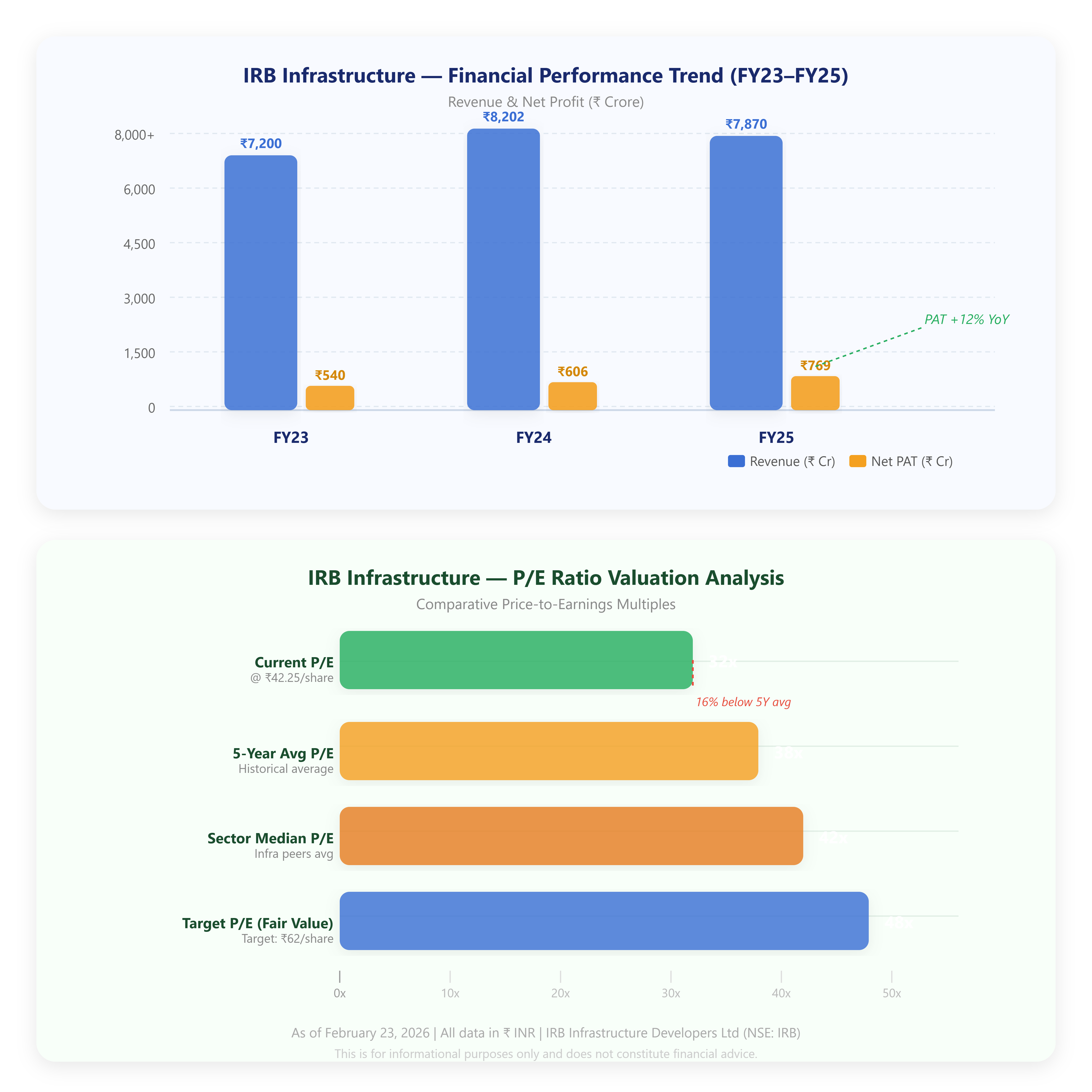
Revenue: FY25 total income came in at approximately ₹8,032 crore versus ₹8,202 crore in FY24 — a marginal 2% decline, largely because construction revenues dipped due to project completion cycles and elections slowing ground activity in the first half of FY25. Over three years (FY23 to FY25), revenue CAGR is roughly 6-7%, which sounds uninspiring. But the real growth story sits in toll revenue — up 23% in FY25 — which is the high-quality, recurring part of the business.
Profit: The more encouraging number — FY25 net profit (excluding an exceptional gain in FY24 from asset sales) rose 12% year-on-year to approximately ₹677 crore. Full-year PAT, including exceptional items, came in around ₹769 crore. In Q3 FY26 (October–December 2025), PAT was ₹210.79 crore — up nearly 50% from Q2 FY26’s ₹140.82 crore. That sequential acceleration matters.
LTM (Last 12 Months) Diluted EPS: Approximately ₹1.31 per share. This looks small only because the share count (~585 crore shares) is large. The real per-share value lives in the asset base — not just reported earnings.
Cash and Debt: This is the honest red flag. The company carries significant debt at the project SPV level. Interest costs and depreciation are substantial, which is why reported earnings can seem disproportionately low for a ₹94,000 crore asset platform. However, CRISIL just reaffirmed the company’s AA-/Stable credit rating — that’s an independent third-party signal that the debt structure is manageable.
Importantly, debtor days improved sharply from 48.8 to 15.9 days — faster collections, better working capital. And NHAI (National Highways Authority of India) claims receivables are expected to come in, which will further ease financial pressure.
SECTION IV: Fundamental Valuation Metrics & Investment Call
Let’s look at the numbers behind the ₹62 target:
P/E Ratio: At ₹42, the stock trades at roughly 32x LTM earnings. That sounds expensive on the surface. But infrastructure BOT companies are typically valued not on P/E alone — the asset base, concession tenure, and cash flow predictability matter more. Historically, this stock has traded between 30-55x during growth phases.
P/B Ratio: Given the complex InvIT structure and large asset base, book value per share understates asset value. The market cap of ₹24,567 crore represents a fraction of the ₹94,000 crore total platform value — that gap tells you something.
ROE and ROCE: These are genuinely modest — in the 5-8% range — because the balance sheet is asset-heavy and leverage is high. It’s not a capital-light tech business. But ROE is improving as toll assets mature and debt gets repaid through operating cash flows.
EPS Growth: Directionally positive. FY25 PAT grew 12% YoY and Q1 and Q3 FY26 showed strong acceleration. The EPC drag is temporary; as the TOT-17 and TOT-18 assets ramp, incremental earnings should compound meaningfully from FY27.
Dividend Yield: The company has declared three interim dividends in FY26 at ₹0.07 each — small in absolute terms, but consistent. Total declared dividends of ~₹181 crore in FY25’s first nine months signals management’s comfort with cash flows.
The Investment Case in Plain English: The stock is down ~30% from its 52-week high of ₹60.95, the business fundamentals are intact, toll revenue is growing at 15-23%, and two large new TOT projects will kick in meaningful cash flows from FY27. At ₹42, you’re essentially buying India’s highway infrastructure at a discount — the market is spooked by construction revenue weakness and high debt levels, but neither is a structural problem. Patient investors with a 3-5 year horizon can accumulate here.
SECTION V: Long-Term Outlook & Risk Assessment
5-15 Year Return Estimate: 12-18% CAGR (base case)
Here’s why. India’s National Infrastructure Pipeline plans for hundreds of thousands of crores in highway investment over this decade. The government’s highway monetisation through TOT is accelerating. This company is the dominant private player in that space. As toll assets mature and debt gets paid down, cash flows to the parent company will rise disproportionately. Think of it like a mortgage — the early years, most of your EMI goes to interest. Once you’re further along, more goes to wealth creation. That’s where several of these projects are heading.
Management has set a stated goal of building an asset base of ₹1 lakh crore — they’re currently at ₹94,000 crore. The last leg of that journey is already partially funded. New project bids (TOT-18 was just added) are expanding the O&M order book by ~20%.
Capital Allocation: The Private InvIT recycling model is smart. They transfer stabilised assets, bring in cash, and redeploy it into new bids — without continuously diluting shareholders or over-burdening the parent’s balance sheet.
Promoter Holding: Promoters hold approximately 30.42% stake, unchanged from a year ago. Stability here is a positive signal — no distress selling.
Risks — Let’s Be Direct:
Debt levels remain elevated. Any spike in interest rates or refinancing stress at project SPV level can hurt near-term profitability.
Construction revenue weakness — the EPC order book has declined. If new BOT/HAM projects don’t get awarded quickly, construction revenue will drag.
Regulatory risk — NHAI periodically disputes toll rates or raises policy concerns. This isn’t frequent, but it’s real.
Traffic growth slowdown — if India’s GDP slows materially, traffic growth could compress from the current 15-23% range to low single digits.
Project delays — toll collection start dates depend on government clearances. Delays push revenues out.
What’s going right:
India’s vehicle population is growing, logistics demands are rising, new expressways are being built, and the government has shown strong commitment to infrastructure spending even during fiscal consolidation years.
Simply put — this is a slow-burn, asset-backed story. Don’t buy it for a quick 20% pop. Buy it because India needs highways and this company builds and operates them better than anyone else in the private sector.
