

Infosys Ltd - Investment Analysis

Investment Thesis & Summary
Infosys is trading at a multi-year low valuation of around 22-23 times earnings despite delivering solid cash flows and maintaining industry-leading margins. The stock’s down about 15% this year while the business keeps churning out money - that disconnect creates an opportunity. The company’s betting big on AI transformation for global clients, and with a massive ₹18,000 crore buyback just completed and promoter confidence staying intact, there’s value sitting on the table if you’re willing to wait for the market to catch up.
Youtube Link:
Business Model & Operations
Here’s how Infosys makes money - they help big companies around the world run their technology better and transform their businesses digitally. Think of them as the behind-the-scenes tech partner for banks, retailers, manufacturers, and healthcare companies. About 57% of their revenue comes from what they call Digital Services - that’s the sexy stuff like AI implementation, cloud migration, cybersecurity, and building new digital products. The rest comes from traditional IT services like maintaining applications and managing infrastructure.
The company works with over 1,800 active clients across North America, Europe, and the rest of the world. North America alone brings in about 60% of revenues. They’re not selling products you can touch - they’re selling their people’s time and expertise, which means their biggest cost is employee salaries. With over 3.2 lakh employees, that’s a lot of payroll.
What’s changed recently?
They’ve gone all-in on AI. Not the hype kind - the practical kind where they’re actually deploying over 2,500 AI projects for clients. They’ve built something called Infosys Topaz, which is basically their AI toolkit that helps clients automate processes and cut costs. In the latest quarter, they signed a $1.6 billion mega deal and have been winning more work than they’re losing, which matters when IT budgets are tight globally.
They’re also expanding through smart acquisitions - recently picked up a 75% stake in Versent Group in Australia to strengthen their cloud and AI presence in that region. The strategy is clear: move up the value chain from being just a body shop to being a strategic partner who can drive actual business transformation.
Historical Financial Review
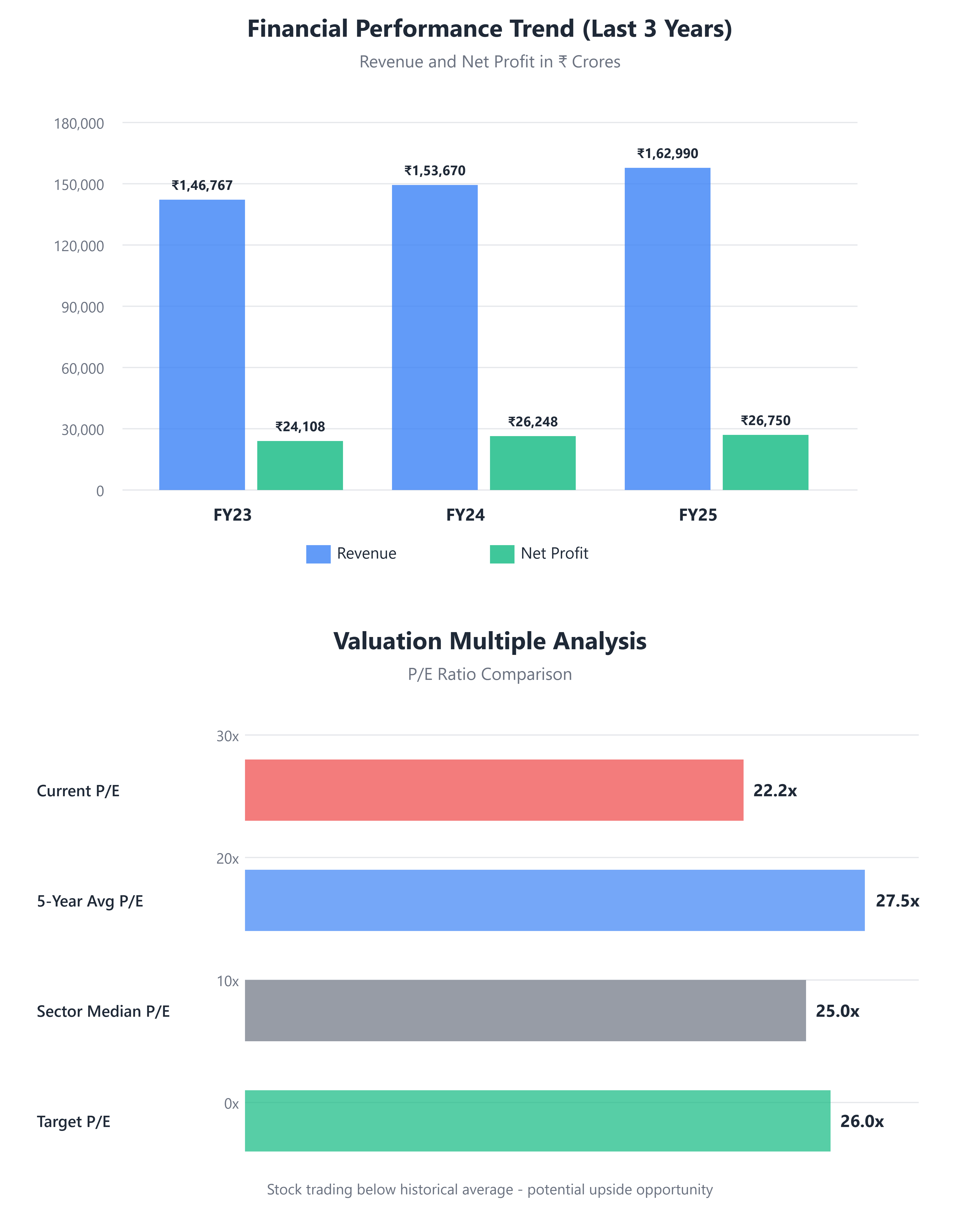
Let’s talk numbers. Over the last three years, Infosys grew revenues at about 10% annually - not explosive, but steady. That took them from ₹1.47 lakh crores in FY23 to ₹1.63 lakh crores in FY25. More importantly, they turned that into ₹64 per share in earnings last year, up from ₹58 three years ago. That’s a profit growth rate of around 6% annually - slower than revenue because margins compressed a bit from 24% to 24% (basically flat).
Here’s what makes them different from most IT companies - their cash generation is ridiculous. In FY25, they generated ₹35,694 crores in operating cash flow. That’s more than their net profit of ₹26,750 crores. Why? Because they collect cash quickly from clients and don’t need much capital to grow. No factories to build, no inventory to manage - just hire smart people and put them to work.
The company’s been returning cash aggressively - paying out about 65-67% of profits as dividends consistently. And they just announced their fifth buyback in a decade, the biggest one yet at ₹18,000 crores. That’s ₹1,800 per share for 10 crore shares. Combined with a ₹23 interim dividend, they’re giving back close to ₹30,000+ crores this year alone.
Debt? What debt? The company is essentially debt-free with borrowings under ₹8,500 crores against a massive cash pile. Their balance sheet is fortress-strong with a book value of ₹249 per share.
The most recent quarter (September 2025) showed they’re holding up well despite global uncertainty. Revenue grew 2.2% sequentially and 2.9% year-over-year in constant currency. Net profit jumped 13% YoY to ₹7,364 crores. Operating margins stayed at 21%, and free cash flow was ₹9,677 crores - that’s 131% of net profit, which is excellent. Management raised their full-year guidance to 2-3% constant currency growth, which shows confidence even in a cautious environment.
Fundamental Valuation Metrics & Investment Call
Now let’s see if the price makes sense. Infosys trades at a P/E of around 22-23 times trailing earnings. Compare that to their own 5-year average of 27-28 times - the stock’s trading about 20% below its historical norm. For a company generating this kind of cash and returning it to shareholders, that’s cheap.
P/B Ratio sits at 7.1 times book value. Sounds high until you realize they’re generating a 29% return on equity. When a company earns almost 30% on its capital, paying 7 times book isn’t crazy - it means the market’s valuing their earning power, not just their assets.
ROE and ROCE are the stars here. ROE has averaged 30% over the last three years, and ROCE is 38%. These are stellar numbers. It means every rupee the company keeps and reinvests generates 30-38 paise of profit annually. That’s the kind of capital efficiency you want.
EPS growth has been steady at 6% over three years. Not spectacular, but remember - they’re paying out 65% as dividends, so they’re choosing to return cash rather than reinvest aggressively. The EPS of ₹64 means at ₹1,600, you’re paying 25 times earnings. In a 5-6% growth environment, that’s reasonable but not a bargain.
Dividend Yield is around 2.8-2.9%. Add in buybacks, and the total shareholder yield (dividends + buybacks) is closer to 6-7% annually. That’s better than fixed deposits and government bonds, with potential for capital appreciation on top.
Here’s the thing - IT stocks are out of favor. The Nifty IT index weight has fallen to its lowest in 18 years. Everyone’s worried about AI replacing these companies. But that fear’s created value. Infosys at 22-23 times earnings with 30% ROE, near-zero debt, and 6-7% shareholder yield isn’t expensive - it’s being ignored.
Long-Term Outlook & Risk Assessment
Looking 5-15 years out, I’d expect 10-14% annual returns from current levels. Here’s the math: earnings should grow 4-6% annually (conservative given their AI pivot), P/E could re-rate back to 26-27 times (not demanding, just mean reversion), and you collect 3% dividend yield along the way. That gets you into double digits.
What’s going right? Management’s spending big on AI capabilities - they’ve trained thousands of engineers on generative AI and are building out their Topaz platform. If even 10% of their AI projects turn into sustained revenue streams, that could add 2-3% to growth rates. They’re also gaining market share in cloud transformation work, and the weak rupee (now ₹90 to the dollar) acts as a tailwind for exporters like them.
Capital allocation looks shareholder-friendly. They’ve returned over ₹60,000 crores in the last 18 months through dividends and buybacks. Promoters hold 14.3% and aren’t selling - that’s stability. Domestic mutual funds have been buying aggressively (now 41% ownership), which suggests institutional confidence.
Now the risks - let’s be honest. Global IT spending is under pressure. Companies are still cautious, especially on discretionary projects. If US or European economies slow down, Infosys feels it immediately. The banking and financial services sector, which is their biggest vertical, is cutting tech budgets.
AI is both an opportunity and a threat. Yes, they’re implementing AI for clients. But AI also automates the kind of work Infosys used to sell as man-hours. If clients need 30% fewer engineers because of AI tools, that squeezes revenues. The question is whether AI-led transformation projects can offset the productivity-driven headcount reduction.
Regulatory stuff is annoying but manageable. They’ve had GST notices (₹13.6 crore penalty recently) and the usual visa issues. The US just raised H-1B visa fees to $100,000, which adds costs. None of this is existential, but it’s a headache.
Competition is intense. TCS is bigger and arguably more stable. Smaller players like HCL Tech and Tech Mahindra are aggressive on pricing. Accenture globally is a beast. Infosys needs to differentiate through AI and consulting, not just by being cheaper.
Valuation risk exists too. If markets stay negative on IT services, the stock could drift lower even if fundamentals improve. That’s why the 5-15 year horizon matters - eventually, cash flows win.
For the India IT sector overall, there’s a structural tailwind - global companies still need cost-efficient tech services, and India remains the best delivery location. Cybersecurity, cloud adoption, and digital transformation aren’t going away. The sector’s growth might slow to mid-single digits, but it won’t die.
Bottom line:
Infosys at ₹1,600 isn’t a screaming bargain, but it’s not expensive either. If you believe they can navigate the AI transition and grow earnings at even 5-6% with steady cash returns, the stock should do fine over time. The downside feels protected by the strong balance sheet and buyback support, while upside comes if sentiment shifts back to IT stocks and their AI strategy pays off.
Disclaimer
This content is for educational purposes only and is not investment or financial advice. Stock markets are subject to risks. Do your own research and consult a qualified advisor before investing. The author is not responsible for any financial losses. Mentions of stocks/companies are not buy or sell recommendations.