

How I Value a Business in 5 Simple Steps

Most people think valuation is about formulas.
It isn’t.Valuation is about judgment.
Numbers help — but only after you understand what the business is actually doing.
Here’s the structure I use.
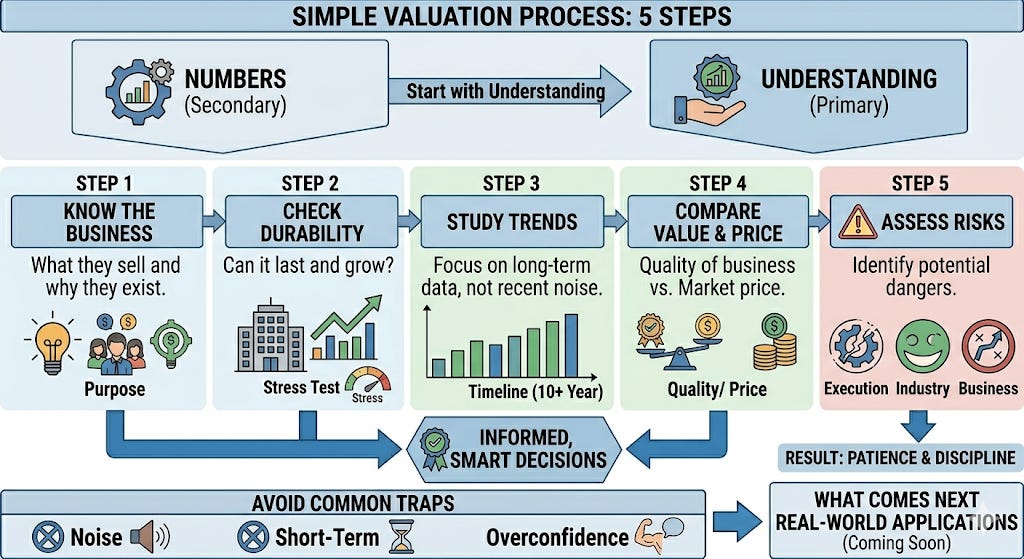
Step 1: Understand the business first
Before touching any numbers, I ask:
What does this company sell?
Who pays for it?
Why does it exist at all?
If I cannot explain the business in a few lines,
I don’t go further.
Clarity comes before calculation.
Step 2: Check if the business can last
I look for signs of durability:
Do customers come back?
Does the company have a reason to stay relevant?
Can it survive a bad year?
A business that cannot handle stress
does not deserve long-term capital.
Step 3: Study long-term numbers, not recent excitement
One good year proves nothing.
I focus on:
Revenue direction over many years
Profit consistency
How debt is handled
I prefer slow and steady over fast and fragile.
Step 4: Compare business quality with price
Only now does price matter.
I ask:
Is the price reflecting reality or emotion?
Is fear pushing the price down?
Is excitement pushing it up?
A good business at the wrong price
is still a bad decision.
Step 5: Be honest about risks
Every company has risks.
I list them clearly:
Business risks
Industry risks
Execution risks
If risks are ignored,
that’s usually where trouble begins.
What this method avoids
This structure keeps me away from:
Noise-driven decisions
Short-term thinking
Overconfidence
It forces patience and discipline.
Why I use this approach
This method won’t make you act fast.
It will make you act carefully.
And in the long run,
careful decisions compound better.
What comes next
The next posts will apply this structure
to real companies.
You won’t just see conclusions.
You’ll see the thinking behind them.