


I get asked some version of this question a lot: “Out of thousands of listed companies, how do you even decide which one to study?”
It’s a fair question. There are close to 5,000 listed companies across the NSE and BSE. Nobody can deeply research all of them, and honestly, nobody should try. Most of them aren’t worth your time.
So before I sit down and spend a week studying one business in depth, like I do every Thursday, I run it through a filter. Not a mysterious one. Just a simple, repeatable process that quietly does most of the work before the real research even begins.
Here’s how that filter works.
Why filtering comes first
Deep research is expensive. Not in money, but in time and attention. Reading annual reports, checking promoter history, understanding an industry, mapping out competitors — this takes real hours.
If I don’t filter first, I’ll spend those hours on companies that were never going to pass a basic quality check anyway. Filtering isn’t about being lazy. It’s about being deliberate with where deep effort goes.
Think of it as five gates. A company has to walk through all five before it earns a full deep-dive.
Gate 1: The quantitative screen
This is the widest gate, and it’s mostly numbers.
I look for:
Consistent Return on Capital Employed (ROCE), not just a single good year
Manageable debt, ideally low or none
Revenue and profit growth that isn’t wildly erratic
Healthy operating margins for the industry the company is in
This step alone cuts the universe down dramatically. Out of thousands, maybe a few hundred survive.
Numbers don’t tell the whole story, but they’re an efficient way to remove companies that were never in the running.
Gate 2: Business quality
Numbers can look good for the wrong reasons. So the next question is simpler and harder to answer: is this actually a good business?
I’m looking for signs of:
Some form of durable advantage — brand, distribution, cost position, switching costs, licenses, anything that makes it hard for a competitor to simply copy the business
Promoters with meaningful skin in the game
A history of allocating capital sensibly, not just growing for the sake of growing
This gate removes companies that had decent numbers but no real moat behind them.
Gate 3: Red flags
This is where I actively look for reasons to say no.
Things I watch for:
Promoter shares pledged to lenders
Frequent auditor changes
Related-party transactions that raise questions
Governance issues, past or present
Anything that smells more like financial engineering than business performance
One serious red flag is often enough to remove a company from consideration entirely, no matter how attractive the numbers looked earlier.
Gate 4: Valuation sanity check
By this point, the pool is already small. But a good business at a foolish price is still a bad decision.
This isn’t about predicting a stock price. It’s a sanity check — is the market already pricing in years of near-perfect execution? If so, there’s very little room for anything to go wrong, and I’d rather wait than chase it.
Gate 5: What’s left
What survives all four gates is a small, short list. Not a list of “buy” ideas. A list of businesses worth spending a full week understanding properly.
That’s the list Thursday’s case studies come from.
The picture, together
Here’s roughly what that funnel looks like in practice:
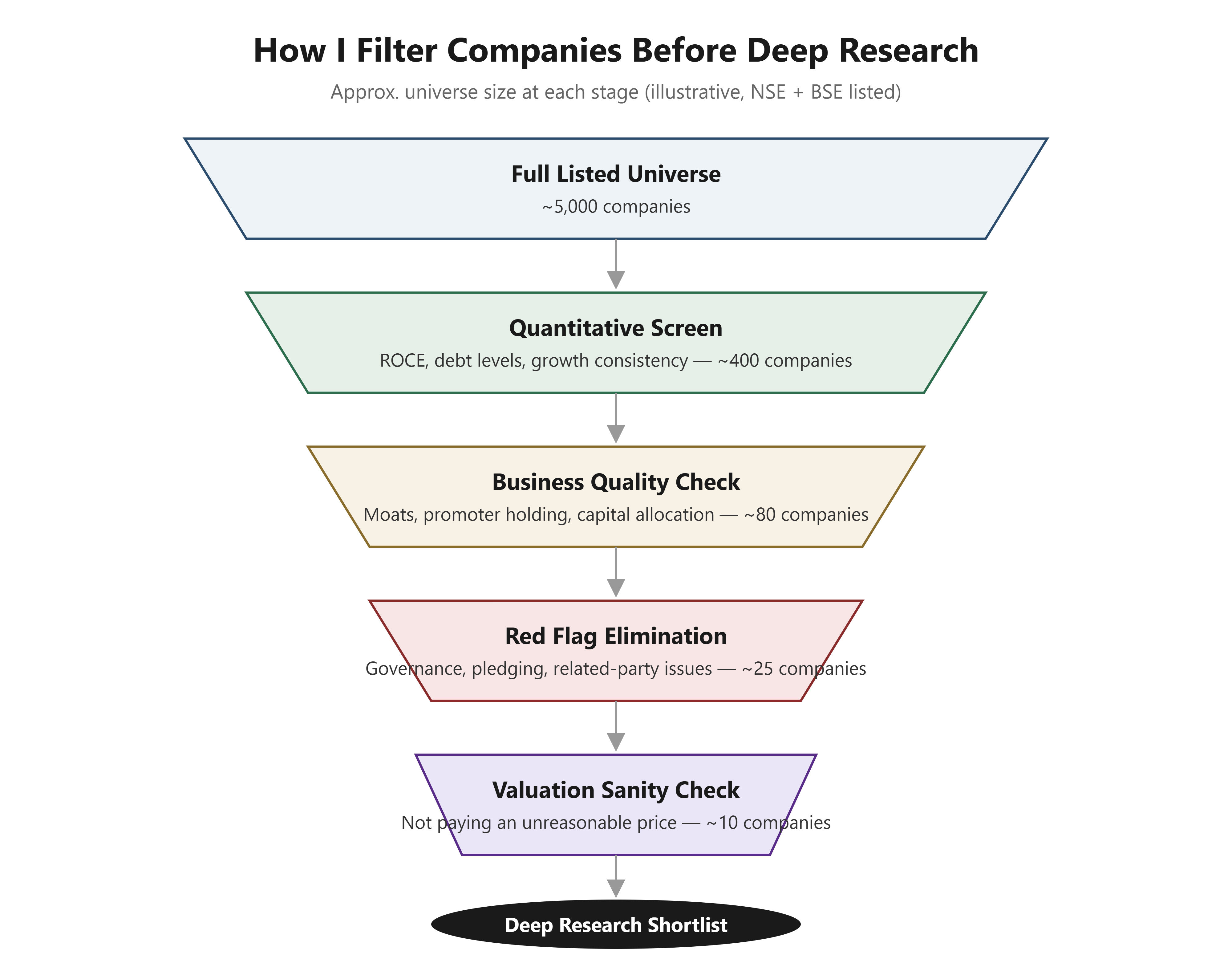
Each gate does less work than you’d expect on its own. It’s the combination, applied consistently, that does the heavy lifting.
Why this matters for you
If you’re building your own process, the lesson isn’t to copy my exact filters. It’s to have filters at all, and to apply them before emotion or excitement enters the picture.
It’s very easy to get drawn into a company because of a good story, a hot sector, or a friend’s tip, and only afterward go looking for numbers to justify it. Filtering first, and only researching what survives, keeps that instinct in check.
This is also why not every Thursday case study will be a company you’ve heard of. Some of the best ones aren’t.
Next Thursday, we’ll take a company through this exact lens, and show you what a full case study built on top of this filter actually looks like.