

Fundamental Analysis vs. Technical Analysis: Core Differences

Picture yourself standing at a stock market fork: one path glimmers with charts and candlesticks, the other’s stacked with balance sheets and earnings reports. Which way do you go? If you’re dreaming of long-term wealth rather than a quick trading thrill, fundamental analysis might just be your golden ticket. It’s all about digging into a company’s true worth—think of it as dating the stock before you marry it—while technical analysis is more like swiping right based on looks alone. In this article, we’ll unpack how fundamental analysis stands apart from technical analysis and why it’s a cornerstone for direct stock investments that last years, not minutes.
What Sets Them Apart?
Fundamental analysis is your deep dive into a company’s soul—its financial health, leadership vibe, and market playground. Technical analysis? That’s the art of reading price wiggles and trading volume squiggles to guess where the stock’s headed next week. Here’s the gist:
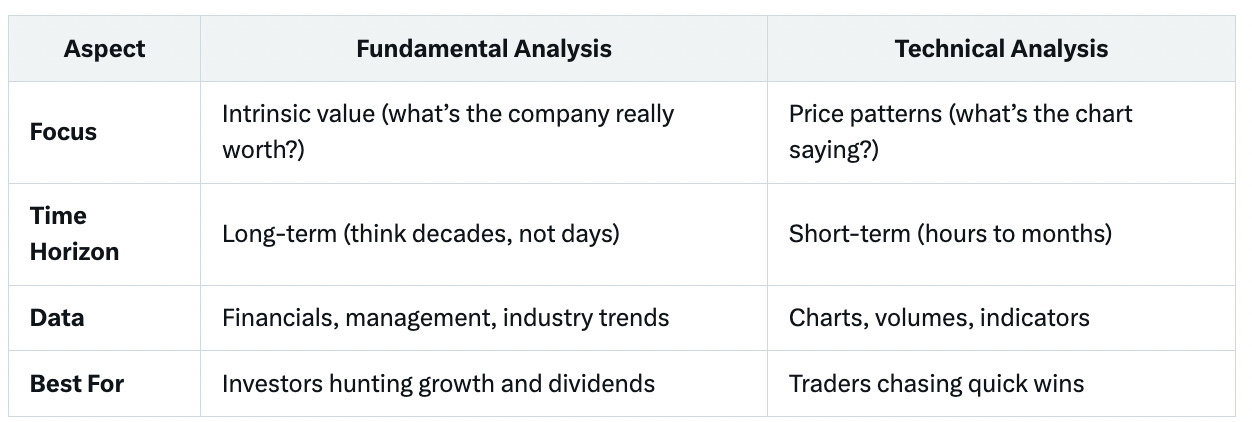
For long-term investors, fundamental analysis is king—it’s about finding undervalued gems or avoiding overhyped duds, not timing the market’s next hiccup.
Breaking Down Fundamental Analysis: The Core Toolkit
So, how do you “do” fundamental analysis? Let’s walk through it with “SolarFuture,” a hypothetical renewable energy star as of April 2025.
Financial Statements: The company’s DNA.
Balance Sheet: SolarFuture boasts $800 million in assets and $300 million in liabilities—solid footing.
Income Statement: Revenue’s at $150 million, with $30 million in net income. Profitable? Check.
Cash Flow: $40 million in free cash flow says they’re not just blowing smoke—real cash is flowing.
Valuation Metrics: Is it a deal?
P/E Ratio: Stock price is $60, earnings per share (EPS) is $2, so P/E is 30. The renewable sector averages 25, but SolarFuture’s growth in green tech might justify the premium.
Quick Tip: Cross-check with P/B (assets) or dividend yield (income) for a fuller picture.
Management Quality: Who’s steering the ship?
SolarFuture’s CEO has a decade of clean-energy wins and hosts clear investor calls—confidence boost activated.
Market Trends: The big picture.
Renewable energy’s booming in 2025, with governments pushing green incentives. SolarFuture’s in a sweet spot, but watch for competitors flooding the market.
Imagine applying this in 2010 to Apple—strong financials and Steve Jobs’ genius would’ve screamed “buy” for the long haul.
Real-World Wins: Fundamentals in Action
Let’s zoom into 2025 sectors. In tech, picture a giant like Microsoft—its cloud growth and steady cash flow make it a fundamental darling. Over in healthcare, a company like Moderna could shine post-mRNA breakthroughs, with R&D spending and patent pipelines hinting at future wins. Then there’s renewable energy—NextEra Energy’s been riding the green wave, its consistent revenue growth a beacon for fundamental fans. Back in the COVID days, Pfizer’s vaccine bets paid off big for those who saw the fundamentals early. These cases prove it: while technical analysis might catch a wave, fundamental analysis builds your surfboard.
Your Next Steps: Invest Smarter
Here’s the deal: fundamental analysis is your long-game superpower. It’s about knowing a company inside-out—financials, leadership, trends—so you can sleep easy with your investments. Start simple: grab a stock’s annual report, calculate a P/E ratio, peek at the CEO’s track record, and skim industry news. Monitor your portfolio by revisiting these basics yearly—has the story changed? Stay patient, ignore the market’s tantrums, and let the fundamentals lead. After all, investing’s a marathon, not a TikTok trend—run it with the right tools, and you’ll finish strong.