

Dividend Growth Investing: Building Wealth in the Indian Market

Dividend Growth Investing
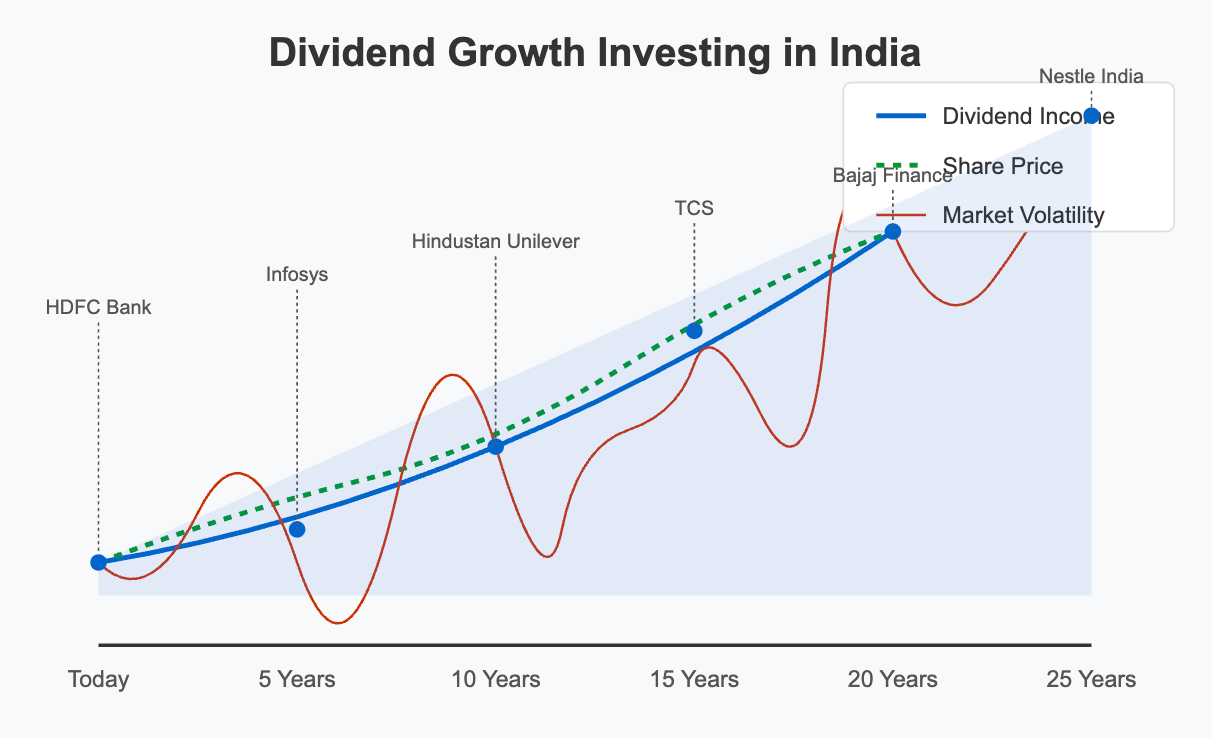
Introduction
Dividend Growth Investing (DGI) represents a strategic approach to wealth building focused on companies that consistently increase dividend payments over time. In the Indian context, this investment philosophy aligns well with the country's growing economy and maturing capital markets. Unlike trading strategies that attempt to time market movements, DGI emphasizes quality, patience, and compounding returns.
Core Principles of Dividend Growth Investing
Focus on Quality: Invest in fundamentally strong companies with sustainable competitive advantages
Prioritize Growing Dividends: Target companies with history of increasing dividend payments
Long-Term Perspective: Maintain holdings through market fluctuations
Compounding Effect: Reinvest dividends to accelerate wealth creation
Reduced Transaction Costs: Minimize buying/selling to improve overall returns
The Indian DGI Advantage
The Indian market presents unique opportunities for dividend growth investors. With GDP growth consistently outpacing developed economies, Indian companies in stable sectors can provide both capital appreciation and increasing dividend income. The maturing regulatory framework and improved corporate governance standards have also enhanced shareholder-friendly policies, including more reliable dividend distributions.
Top Dividend Growth Stocks for Long-Term Investment
Banking & Financial Services
HDFC Bank (HDFCBANK)
Consistent dividend growth averaging 15% annually
Strong capital position and quality loan book
Expanding digital footprint positions it well for 20+ year growth
Dividend yield: 1.2-1.5%
Bajaj Finance (BAJFINANCE)
Robust growth trajectory and expanding product portfolio
5-year dividend CAGR of ~18%
Fintech integration provides long-term competitive advantage
Ideal 10-15 year holding for dividend growth acceleration
Information Technology
Tata Consultancy Services (TCS)
Exceptional dividend history with special dividends
Cash-rich business model with minimal capital requirements
Global client base provides revenue stability
15-25 year investment with dividend yield potential of 3-4% at maturity
Infosys (INFY)
Strong free cash flow generation supporting dividend increases
Committed to returning 85% of free cash flow to shareholders
Technology transformation positions it well for 10-15 year growth
Current dividend yield: 2-2.5%
Fast-Moving Consumer Goods (FMCG)
Hindustan Unilever (HINDUNILVR)
Defensive business with consistent dividend payouts
Deep distribution network and brand moat
Well-positioned for India's consumption growth story
Ideal 15-20 year holding with steadily increasing dividend yield
Nestle India (NESTLEIND)
Premium valuation justified by consistent performance
Strong dividend payer with 5-year CAGR of 12%
Product innovation pipeline supports long-term growth
Excellent 20-25 year compounding opportunity
Energy & Utilities
Power Grid Corporation (POWERGRID)
Regulated business model ensures stable cash flows
High dividend yield of 4-5% with growth potential
Government backing provides investment safety
5-10 year hold for income-focused investors
NTPC (NTPC)
Transitioning to clean energy while maintaining dividend strength
Dividend yield significantly above market average at 3-4%
Government ownership ensures policy support
10-15 year holding recommended as energy transition unfolds
Manufacturing & Materials
Larsen & Toubro (LT)
Infrastructure sector leader with increasing dividend policy
Beneficiary of India's long-term infrastructure development
International expansion provides growth avenues
10-20 year investment thesis aligned with India's development goals
Asian Paints (ASIANPAINT)
Premium valuation justified by 20%+ ROE
10-year dividend CAGR of ~25%
Dominant market position with pricing power
15-25 year holding for significant dividend income growth
Implementation Strategy
Build a Core Portfolio: Allocate 60-70% to established dividend growers like HDFC Bank, TCS, and Hindustan Unilever
Add Growth Components: Include 20-30% in rapidly growing dividend payers like Bajaj Finance and Asian Paints
Include High-Yield Stability: Allocate 10-20% to higher-yield utilities like Power Grid and NTPC
Systematic Investment: Use market corrections to add to positions rather than attempting to time entries
Dividend Reinvestment: Set up automatic dividend reinvestment where available or manually reinvest quarterly
Regular Review: Annually assess dividend growth rates and company fundamentals, not price movements
Common Mistakes to Avoid
Chasing Yield: High current yields often indicate problems with sustainability
Ignoring Payout Ratios: Dividends should be supported by earnings (ideal payout ratio: 30-60%)
Neglecting Growth: Current yield matters less than dividend growth trajectory
Selling During Volatility: Market fluctuations are opportunities, not signals to exit
Inadequate Diversification: Even quality companies face sector-specific challenges
Measuring Success
The true measure of a successful DGI strategy isn't short-term price appreciation but rather:
Annual growth in dividend income
Total return (dividends + capital appreciation) versus broader indices over 5+ year periods
Reduced portfolio volatility compared to market indices
Conclusion
Dividend Growth Investing in India offers a compelling approach for patient investors seeking to build substantial wealth over decades. By focusing on quality companies with growing dividends, investors can harness the power of compounding while avoiding the pitfalls of market timing. As Warren Buffett advises, "Time is the friend of the wonderful company, the enemy of the mediocre." The Indian market, with its structural growth drivers and improving corporate governance, provides fertile ground for this investment philosophy to flourish over the next 5-25 years.
Retry
Claude can make mistakes.
Please double-check responses.
Excellent concept. I saw someone applying DGI for Indian market for the first time. Great work. Just one request. Can you please do similar substack on mid and small caps listed in India? 🙏🏻