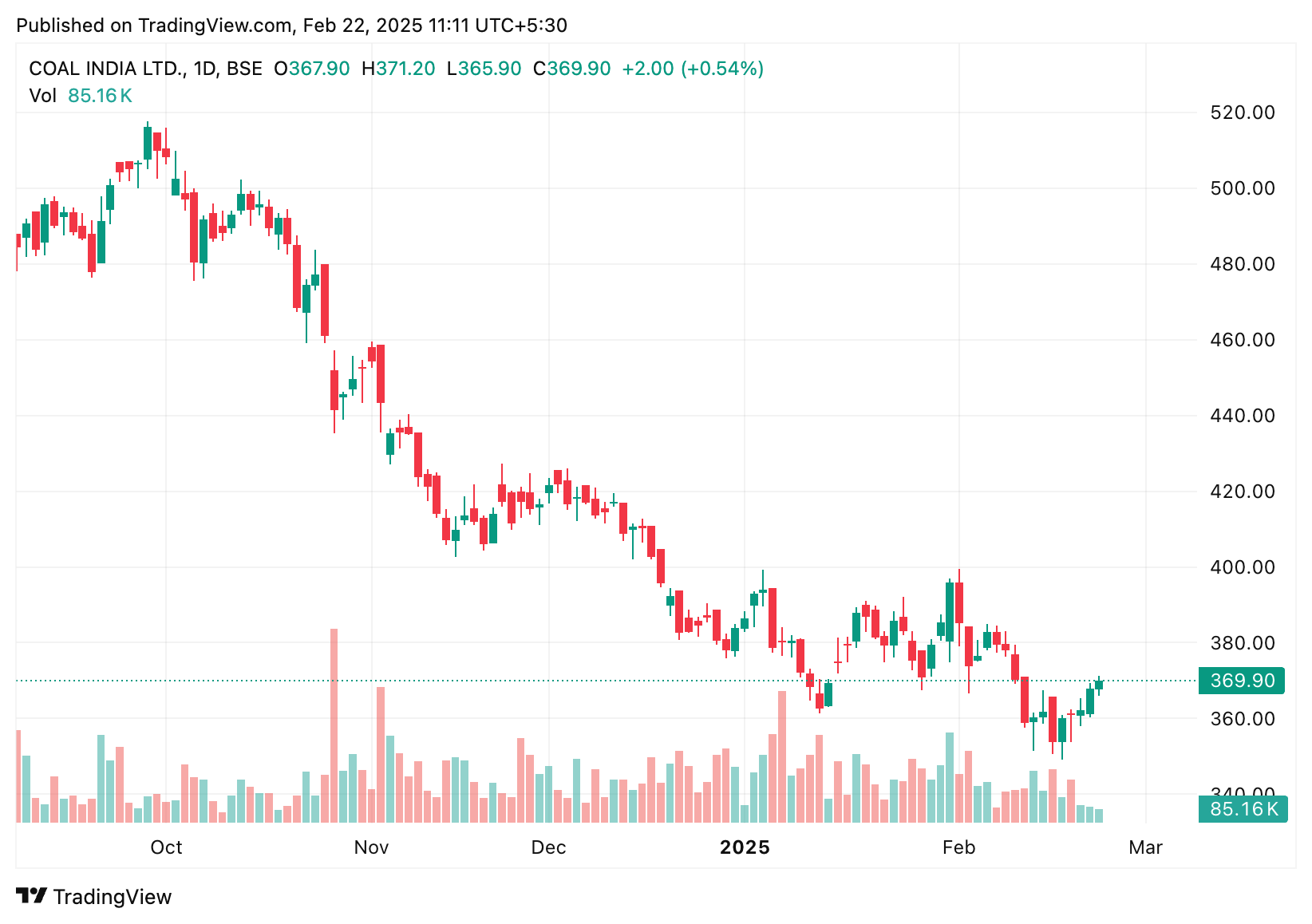
Coal India Ltd (NSE: COALINDIA): Navigating Headwinds with Strategic Diversification – Q3 FY2025 Results

Introduction: The Coal Conundrum in India’s Energy Landscape
India’s energy demand is soaring, with coal still fueling ~70% of its power generation. Yet, as renewables gain momentum, Coal India Ltd (CIL)—the world’s largest coal producer—faces a pivotal moment. Q3 FY2025 results reveal a company balancing short-term pressures with ambitious diversification. Let’s unpack the numbers, strategies, and whether CIL remains a compelling investment.
Q3 FY2025 Financial Performance: Decoding the Dip
Revenue & Profit Dynamics
Revenue: ₹32,359 Cr (-2% YoY)
Why the decline? Global coal prices softened due to oversupply (e.g., Indonesia ramping up exports) and milder winters in Asia reducing demand.
PAT: ₹8,491 Cr (-17% YoY)
Key drags: Rising contractual expenses (+17% YoY) from outsourced mining amid labor shortages, and a 46% spike in depreciation due to accelerated machinery investments.
Operational Efficiency
EBITDA Margin: 41.3% (up from 40.6% in 9M FY24) reflects cost-control wins, like a 3% drop in employee costs (VRS schemes reducing headcount).
Coal Production/Offtake: 202 MT (+2% YoY) and 194 MT (+2% YoY), respectively. Steady growth, but below FY26’s 700 MT target pace.
Growth Initiatives: Beyond Coal
1. Coal Gasification & SynGas (MoU with BPCL)
What’s the buzz? Coal gasification converts coal into Synthetic Natural Gas (SNG), a cleaner alternative for industries like fertilizers.
Strategic Play: Aligns with India’s ₹8,500 Cr incentive scheme for coal gasification, aiming to curb LNG imports (30% of demand). CIL’s ₹1,350 Cr grant for 3 projects could yield 3.8 MTPA SNG by 2030.
2. Critical Minerals (MoU with IREL)
Target Minerals: Rare earths (e.g., lithium, cobalt) critical for EVs and batteries. IREL’s expertise in beach sand minerals could unlock non-coal revenue.
3. Renewable Energy (50 MW Solar at NCL)
Bigger Picture: CIL targets 3 GW solar capacity by 2026. This 50 MW plant is a drop, but signals intent to offset carbon emissions (Scope 1 & 2).
4. Production Expansion
700 MT by FY26: Requires ~10% annual growth. Challenges? Land acquisition delays and rail logistics. Recent CAPEX in rail infrastructure (₹2,100 Cr allocated in FY25) aims to reduce evacuation bottlenecks.
CAPEX & Modernization: Fueling Future Growth
₹16,500 Cr CAPEX (FY25):
60% toward mine development (e.g., new greenfield projects in Odisha).
25% on HEMM procurement (e.g., autonomous trucks, AI-driven drills) to boost output per employee.
15% on rail corridors (e.g., Tori-Shivpur line) to slash transport costs (currently 25% of revenue).
Competitive Landscape: Strengths vs. Rising Risks
Strengths
Monopoly Power: Controls 80% of India’s coal, with 52 mines under development.
Government Backing: Ensures offtake security (90% of sales to power/steel sectors).
Risks
ESG Pressures: Global funds (e.g., Norway’s SWF) divesting from coal. CIL’s renewables push may ease but not eliminate ESG concerns.
Regulatory Overhang: Subsidized pricing for power plants (₹1,400/ton vs. ₹2,500/ton global prices) caps profitability.
Valuation: Deep Value or Value Trap?
P/E of 6.6x: Discount to global peers (Peabody Energy: 8.2x, China Shenhua: 9.1x).
Dividend Yield 6.89%: Supported by a 7-year average payout ratio of 75%.
ROCE/ROE: 63.6%/52% reflect unparalleled asset efficiency in mining.
Bear Case: Coal’s terminal decline accelerates, dragging valuations.
Bull Case: Coal demand peaks post-2030 in India; gasification/renewables add ₹15,000 Cr revenue by 2030.
Investment Thesis: Stability Meets Transition
CIL suits:
Income Investors: High, stable dividends (payouts likely amid government ownership).
Value Hunters: Cheap metrics pricing in coal’s demise prematurely.
Cautious Optimists: Bets on India’s coal demand (projected +4% CAGR to 2030) and CIL’s strategic bets.
Monitor: FY26 production targets, gasification project timelines, and global coal prices.
Conclusion: A Calculated Gamble on India’s Energy Bridge
Coal India isn’t just a coal play—it’s a transition story. While regulatory and ESG risks loom, its monopoly, dividends, and diversification offer a unique hedge in a volatile energy market. For those patient enough to navigate the sector’s twilight years, CIL could deliver steady returns.
Disclaimer: This analysis is informational. Consult a financial advisor before investing.
Engage Further: What’s your take—can Coal India pivot fast enough to outpace coal’s decline? Comment below!
Visual Elements (Conceptual):
Infographic: CIL’s revenue streams (2025 vs. 2030 projections).
Chart: Global coal prices vs. CIL’s PAT (5-year trend).
Map: Key CIL mines and upcoming gasification plants.
Subscribe for deep dives into India’s industrial giants! 🔍📈