

Capital Allocation: What Management Actually Does With Profit

Two companies can report the exact same profit this year and end up in completely different places five years from now. The difference almost never comes down to how much they earned. It comes down to what they did with it afterward.
This is capital allocation, and it’s one of the most underrated skills an investor can learn to read. Profit is the input. What management chooses to do with that profit is the decision that actually compounds, or quietly erodes, shareholder value over time.
Profit is a number. Allocation is a decision.
When a company earns profit, that money doesn’t just sit there waiting to be reported next quarter. Management has to decide what to do with it, and every rupee kept in the business is a rupee no longer available to be spent some other way.
Broadly, there are five places that profit can go:
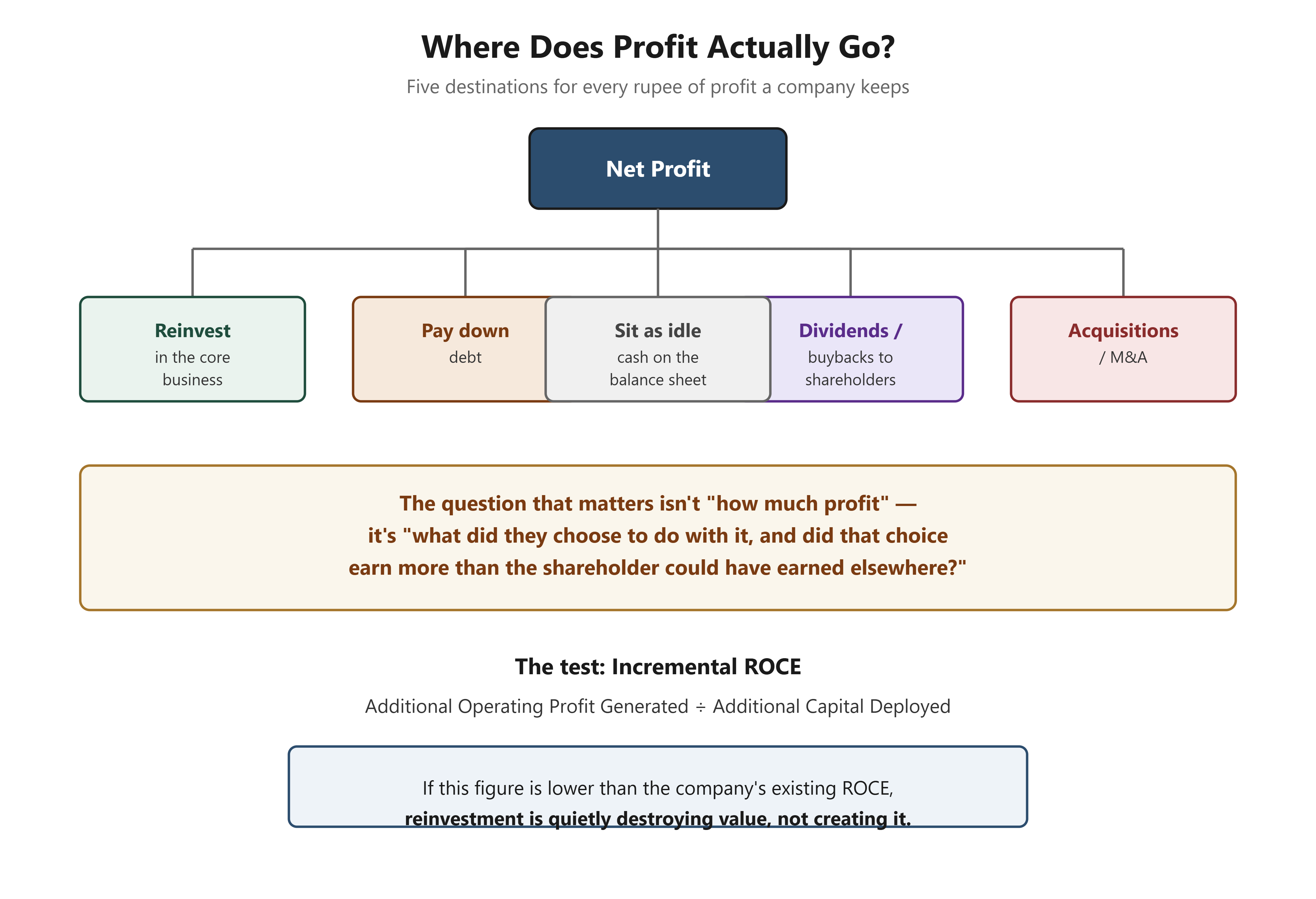
Reinvest in the core business — new capacity, new products, working capital to support growth
Pay down debt — reducing financial risk and interest costs
Return it to shareholders — through dividends or share buybacks
Acquire other businesses — expanding through M&A rather than organic growth
Let it sit as cash — sometimes deliberately, sometimes by default
None of these choices is automatically right or wrong. A capital-intensive business early in a growth cycle probably should reinvest heavily. A mature, slower-growing business with limited reinvestment opportunities probably should return more cash to shareholders. The mistake is assuming one is always superior to the other, or that a company is doing well simply because profit is growing, without asking what happened to that profit next.
The test that actually matters: incremental ROCE
Here’s the single most useful question to ask about any reinvestment decision: for every additional rupee of capital the company deployed, how much additional operating profit did that generate?
This is called incremental Return on Capital Employed, and it’s calculated as:
Additional Operating Profit Generated ÷ Additional Capital Deployed
If a company’s overall ROCE has historically been, say, 20%, but the incremental ROCE on its most recent round of reinvestment is only 8%, that’s a meaningful warning sign. The company isn’t wrong to reinvest, but it may be running out of genuinely attractive opportunities to deploy fresh capital at the same quality it achieved in the past. Growing revenue by pouring in capital at a lower return than the existing business earns doesn’t create value. It dilutes it, even while the headline profit number keeps climbing.
This is also why revenue growth and profit growth, on their own, can be misleading. A business can grow both every year while quietly becoming a worse and worse place to have deployed each new rupee of capital.
Reading dividends and buybacks correctly
When a company returns cash to shareholders instead of reinvesting it, that’s not automatically a sign of weakness, and it’s not automatically a sign of shareholder-friendliness either. It depends on why.
A mature, cash-generative business with genuinely limited reinvestment opportunities, returning excess cash rather than chasing growth for its own sake, is often making the right call. The alternative, forcing capital into lower-return projects just to show growth, usually ends up destroying value slowly and invisibly.
On the other hand, a company that pays out cash while simultaneously borrowing to fund its actual operations is a different story entirely, and worth questioning directly.
Reading debt reduction
Paying down debt is often treated as an unambiguously good use of profit, and most of the time it is, especially for a company that’s carrying meaningful leverage. But it’s worth checking whether debt reduction is happening because the company generates genuine free cash flow, or because it’s been forced to, after a period of overextension. The first is disciplined. The second is a business correcting a mistake it probably shouldn’t have made in the first place.
Reading acquisitions
This is where capital allocation gets hardest to judge from the outside, because the payoff, if there is one, often takes years to show up in the numbers.
A few questions help cut through the noise:
Is the acquisition in a business the company genuinely understands, or a step into something unrelated?
Was it funded with cash, debt, or new shares, and what did that funding choice cost existing shareholders?
Did the price paid look disciplined, or did it look like management was chasing size for its own sake?
Serial acquirers deserve particular scrutiny. A string of acquisitions can flatter revenue growth for years, while the actual returns on all that deployed capital quietly disappoint, hidden inside a growing, more complex set of financial statements.
Idle cash isn’t automatically safe
It’s tempting to think a large cash pile on the balance sheet is a purely conservative, low-risk position. Sometimes it is. But cash earning a low return, sitting unused for years with no clear plan, is itself a form of capital misallocation. Shareholders’ money is meant to be working somewhere, either inside the business or back in their own hands to redeploy themselves. A persistently bloated cash balance, with no articulated plan and no returns to shareholders, is worth asking management about directly rather than assuming it’s simply prudent.
Why this matters more than the profit number
Profit tells you what a business earned in a single year. Capital allocation tells you what kind of custodian management is likely to be with everything the business earns going forward. Over long enough periods, the second question matters more, because a business run by a management team that consistently reinvests wisely, returns cash sensibly, and avoids empire-building compounds in a way that a business with the same profit but poor allocation habits simply cannot.
The next time a company reports strong profit growth, the more useful follow-up question isn’t “how much did they make.” It’s “what did they do with it, and would you have made the same choice with your own money.”
Next Monday, we’ll look at something that sits right next to this topic: how to judge management quality itself, beyond just the numbers they report.
Topic is critical but would have made more sense with examples and actual case studies