

Avenue Supermarts Limited redefined Indian retail through relentless efficiency, scale, and execution.

SECTION I — Investment Thesis & Summary
Here’s the situation in plain terms. One of India’s finest retail businesses has quietly become one of its most undervalued-relative-to-history stocks. The share is sitting about 25% below its 52-week high. The earnings engine is actually picking back up — profits jumped nearly 18% last quarter. Yet the stock barely gets credit for it.
Why?
Quick commerce. Blinkit, Zepto, Swiggy Instamart — the market is spooked that 10-minute grocery delivery will eat this company’s lunch. That fear is partially valid but massively overpriced into the stock right now. This is the kind of setup long-term investors remember fondly — a great business, a real but manageable threat, and a price that reflects the worst case.
SECTION II — Business Model & Operations
Let’s start with what makes this company tick. It runs India’s most successful hypermarket chain — big-box stores, typically 20,000–55,000 square feet, stocking everything from rice and dal to TVs and shoes. The model is almost embarrassingly simple: buy more than anyone, pay less than anyone, sell cheaper than anyone. They call it Everyday Low Cost – Everyday Low Price, or EDLC-EDLP. It has worked with stunning consistency for over two decades.
As of January 2026, the store count stands at 444. They added 50 new stores in FY25 and are continuing that pace in FY26. The expansion is disciplined — they go deep in existing clusters before jumping to new cities. Western India (Maharashtra, Gujarat) remains the core heartland, but their footprint now spans Telangana, Karnataka, Rajasthan, Punjab, and beyond.
The business breaks down into three buckets: Foods (groceries, staples, dairy — about 57% of revenue), Non-Foods FMCG (personal care, home care — about 20%), and General Merchandise & Apparel (kitchenware, clothing, electronics — about 23%). Foods is the traffic driver; General Merchandise is where the margin lives.
One important structural shift worth noting: DMart Ready, their online grocery arm, has been downsizing. They shut operations in five cities while adding fulfillment centers only in existing markets. Management has effectively said: we’re not going to burn money chasing quick commerce. That’s either discipline or denial — the jury is still out — but it shows what they stand for.
There’s also a leadership transition in play. Neville Noronha, the outgoing CEO who ran the ship through the post-COVID expansion, is being succeeded by Anshul Asawa as CEO. A management change at any company is worth watching, but Asawa comes from within the organization, and the operating philosophy is deeply embedded in company culture. Disruption risk here looks minimal.
Youtube Link:
SECTION III — Historical Financial Review
The numbers tell a story of steady, if decelerating, growth. Let’s walk through the last three fiscal years.
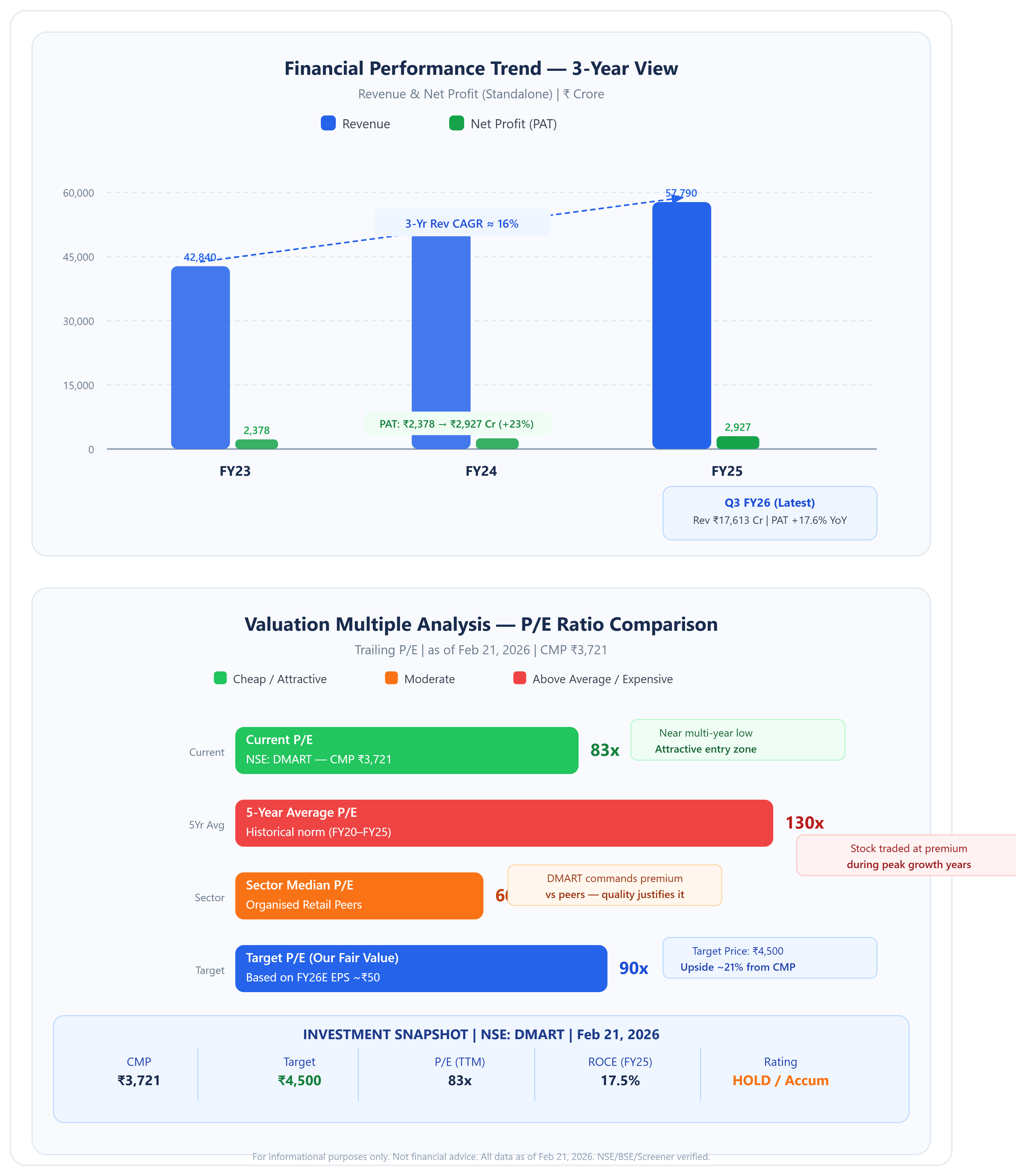
In FY23, the company clocked revenue of ₹42,840 Crore and a net profit of ₹2,378 Crore. That was a blockbuster year — coming off COVID recovery with consumers flooding back to physical stores and volumes surging. EBITDA margins were a healthy 8.5%.
FY24 saw revenue climb to ₹50,789 Crore, up about 18.6%. Sounds good, right? But net profit only inched up to ₹2,536 Crore — a 6.6% rise — because margins started compressing. EBITDA margin slipped to 8.1%. This is when the narrative started to change. Same-store growth (what analysts call like-for-like or LTL sales) decelerated. The quick commerce fear went mainstream.
FY25 was more of the same story, but the numbers weren’t terrible. Revenue hit ₹57,790 Crore — 16.7% growth. EBITDA reached ₹4,543 Crore. Net profit came in at ₹2,927 Crore — an 8.6% rise. Margins held around 7.5-8%. Not the glory days, but not disaster either. The 3-year revenue CAGR clocks in at approximately 17-18% — respectable for a business of this size.
The real green shoot appeared in Q3 FY26 (October-December 2025). Revenue grew 13.2% to ₹17,613 Crore standalone, but more importantly, PAT jumped 17.6% to ₹923 Crore. EBITDA margins expanded to 8.4% — the first meaningful uptick in two years. That margin recovery, if it sustains, is the most important data point in this entire story right now.
Cash position is solid. The company is virtually debt-free — interest coverage sits at 53.9 times earnings, which is almost comically comfortable. Operating cash flow for FY25 was approximately ₹2,463 Crore. They are not paying dividends — all surplus cash goes into new store capex and land acquisition. That’s fine for a company still in expansion mode.
TTM diluted EPS stands at approximately ₹41.61. If Q3 FY26’s momentum continues, FY26 full-year EPS could land in the ₹48-52 range.
SECTION IV — Fundamental Valuation Metrics & Investment Call
Let’s be direct about the numbers.
P/E Ratio: The stock trades at roughly 83x trailing earnings. That sounds expensive — and in absolute terms, it is. But this company has historically traded at 120–150x earnings during normal times. At 83x, it’s near a multi-year low on this metric. The market is effectively pricing in a permanent slowdown. If margins recover — and Q3 FY26 suggests they might — this re-rating could happen quickly.
P/B Ratio: At 10.83x book value, you’re paying a significant premium for quality. But for a business that generates 17%+ ROCE on an asset-light model with owned stores (not leased — a key competitive moat), that’s arguably fair.
ROE & ROCE: Return on Equity came in at 12.7% for FY25, down from 13.6% in FY24. ROCE was 17.5% — still well above the sector average of roughly 10%. These numbers have been declining as the company invests in new stores and the earnings growth hasn’t quite kept up. Watch these in FY26 — they should start recovering.
EPS Growth: FY23 EPS was ₹36.72. FY24 was ₹38.99. FY25 was ₹41.61. The growth has been frustratingly slow — single-digit every year — when the market once expected 15-20% annual earnings growth. That’s precisely why the stock has derated. But the FY26 trajectory, with three consecutive quarters of accelerating PAT growth, is beginning to show a recovery.
Dividend: Zero. No dividends, no buybacks. Every rupee goes back into the business. For pure income investors, look elsewhere. For compounders, this is how DMart has historically created wealth.
Target Price Basis: At 90x earnings on estimated FY26 EPS of ₹50, you get ₹4,500. That’s a realistic fair value — not a bull case. A bull case at 110x FY26 EPS takes you to ₹5,500. The bear case (quick commerce accelerates, margins contract further) at 70x FY26 EPS puts fair value near ₹3,500 — which is roughly where you’d want to load up aggressively.
SECTION V — Long-Term Outlook & Risk Assessment
5 to 15 Year Return Estimate: 12% to 18% CAGR
Here’s the multi-decade case for this business. India’s organized retail penetration is still below 15% of total retail. The country will add 200-300 million middle-class consumers over the next decade. Physical grocery retail — done at scale, with owned stores, with the lowest prices in the catchment — is structurally attractive for anyone willing to own it through cycles.
Management’s strategy is clear: keep adding 40-50 stores per year, own the real estate wherever possible, and never compromise on price positioning. They’re spending approximately ₹2,200-2,500 Crore annually on store expansion and infrastructure. The pipeline is healthy. Store count could realistically hit 650-700 by FY30.
The promoter group, led by Radhakishan Damani — one of India’s most respected value investors — holds 74.6% of the company. The holding has remained broadly stable. When a founder of that caliber doesn’t sell, it means something.
Now the risks — and they are real.
Quick commerce is not a fad. Blinkit, Zepto, and Swiggy Instamart collectively have 25-30 million monthly active users and growing. In metro areas, convenience is increasingly winning over price. DMart’s core value proposition — lowest prices — is being directly attacked by platforms offering matching or deeper discounts on FMCG. The LTL (same-store) growth of 5.6% in Q3 FY26 is among the slowest on record for this company.
DMart’s exposure to Tier 1 and Tier 2 cities in Maharashtra and Gujarat means a significant share of its customer base is prime quick commerce territory. In smaller towns — Tier 3 and beyond — DMart remains dominant and relatively insulated. But that’s not where the premium growth was assumed to come from.
Margin risk is two-sided. Commodity deflation (like in staples this quarter) can suppress revenue growth even when volume is solid. Meanwhile, any labor code implementation or wage inflation puts pressure on a labor-intensive format.
Competition isn’t limited to quick commerce either. Reliance Retail, with its JioMart and Smart Bazaar formats, is actively expanding into DMart’s territory with the full weight of Reliance’s supply chain and capital behind it.
The bottom line. This is a fundamentally exceptional business going through a fundamentally real challenge. The stock has already corrected significantly to reflect the new competitive reality. At current prices, most of the bad news looks priced in — but patience is required. The investment case is not “buy and forget.” It’s “buy with conviction, monitor the LTL trend, and add more if margins recover through FY26-27.”