

Arvind SmartSpaces Limited: Evaluating the Multibagger Potential in Indian Realty

SECTION I: Investment Thesis & Summary
This is a mid-cap real estate developer that more than doubled its revenues in a single year, is backed by one of India’s oldest and most respected industrial houses, and is sitting nearly 40% below its 52-week high. The market is giving you a second chance at a compelling price, and in a sector where India’s structural tailwinds are arguably the strongest they’ve been in two decades.
This is not a speculative bet. It’s a systematically growing developer with institutional-quality execution in an expanding geography. The correction is valuation-driven and sentiment-led — not fundamental.
SECTION II: Business Model & Operations
The company builds homes and townships — plotted developments, villa communities, luxury apartments, and mid-income residential housing. It operates primarily in Gujarat (Ahmedabad and Surat) and Bengaluru, and has recently made a significant push into the Mumbai Metropolitan Region (MMR).
Here’s what makes this model interesting: most of their best-performing projects are in the horizontal segment — plots and villas — which are comparatively asset-light, fast to monetize, and high-margin. Their revenue recognition model is completion-based, which means quarterly numbers can look lumpy, but the underlying bookings momentum tells the real story.
The company’s project pipeline has expanded aggressively. In FY25 alone, they entered MMR with a ₹1,500 Crore horizontal township project near Khopoli, launched a ₹1,350 Crore mega industrial park in Ahmedabad across ~440 acres, and added another plotted development in Sanand (Ahmedabad) worth ₹600 Crore. Their total ongoing project portfolio stands at 26.9 million square feet, with a planned pipeline of 43.5 million square feet — that’s real scale.
The business is also structurally capital-efficient. A large portion of the new projects are through Joint Development (JD) models — they bring the development expertise, the partner brings the land, and they share the revenue. This keeps the balance sheet relatively clean while still building a massive execution pipeline.
They are the real estate arm of the Lalbhai Group, a ₹15,000+ Crore conglomerate. That parentage matters for credibility in land acquisition, banking relationships, and customer trust.
Youtube Link:
SECTION III: Historical Financial Review
Let’s talk numbers that actually mean something.
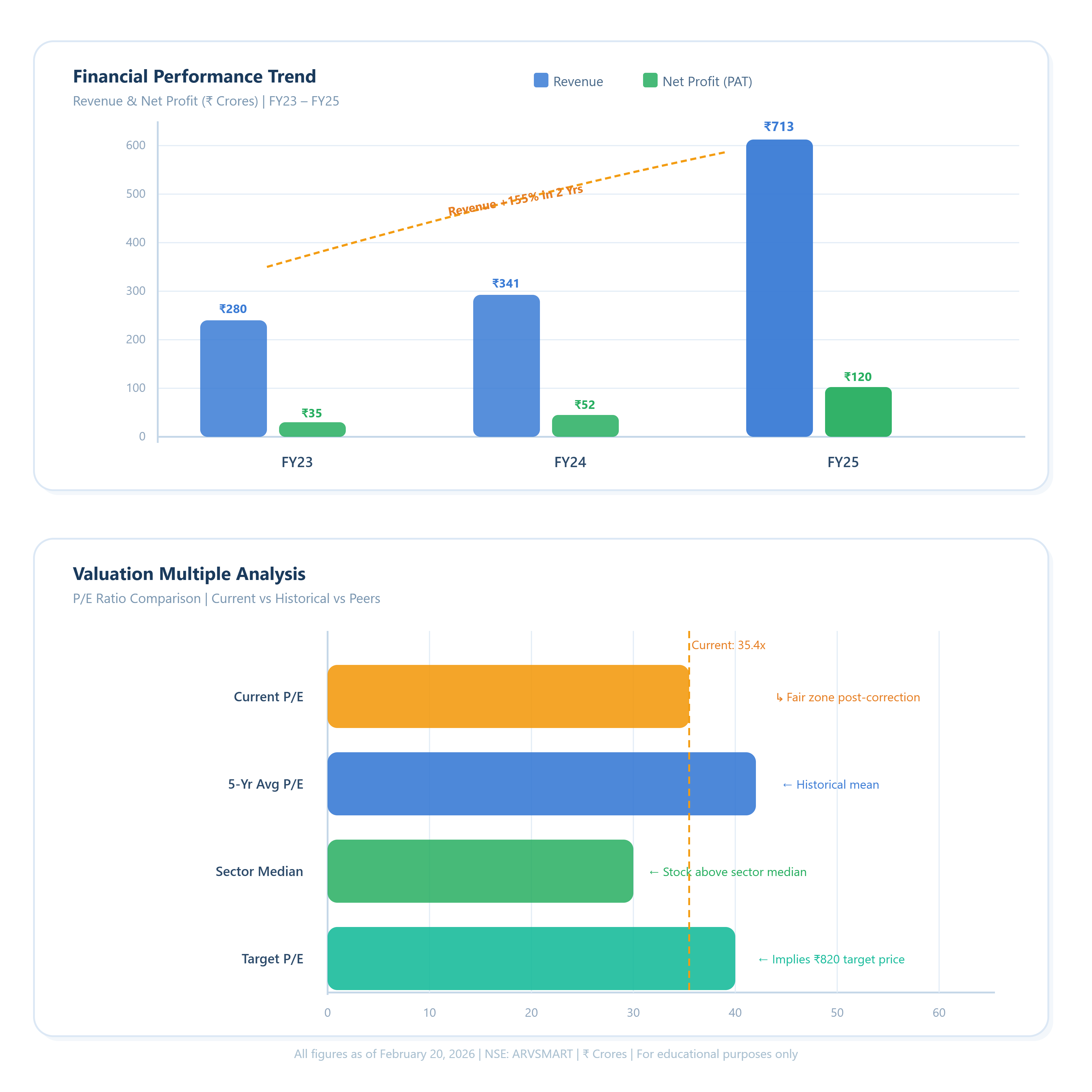
Revenue has exploded. In FY24, the company did ₹341 Crore in revenue. In FY25, that number nearly doubled to ₹713 Crore — a YoY jump of ~109%. Over a three-year window (FY22 to FY25), the revenue CAGR is approximately 55-60%. That is exceptional growth even by Indian real estate standards.
Net profit followed suit. FY23 PAT was around ₹35 Crore. FY24 came in at ₹52 Crore. FY25 saw the number leap to ₹120 Crore — a 131% single-year jump. That’s not just top-line expansion; margins expanded meaningfully too, with operating margins touching 25-28% in peak quarters of FY25.
The full-year FY25 diluted EPS landed at ₹24.25 per share. At today’s price of ₹565, you’re paying 23x trailing earnings. The trailing twelve-month P/E (which includes the softer H1 FY26 quarters) expands to about 35x — still reasonable for the growth runway ahead.
There’s one important nuance to flag: FY26 H1 (Apr–Sep 2025) has been significantly weaker versus the same period in FY25. Revenue dropped ~46% YoY in Q2 FY26, and net profit fell ~65% over the same comparison. This has spooked the market and is the primary reason the stock is down 37% from its highs.
However, here’s the context: FY25 H1 was unusually strong because of concentrated project completions and specific large deliveries. The business inherently lumps around completion cycles — this is typical for real estate revenue recognition under Ind AS. The Q3 FY26 numbers (Dec 2025 quarter) have started to recover, with revenue of ₹166 Crore and PAT of ₹29 Crore — a clear sequential improvement. The recovery is already underway.
Cash generation is healthy. The company paid ₹6 per share as dividend for FY25, translating to a dividend yield of ~1.06% at current prices. Net debt is manageable and the company has been disciplined about leverage.
SECTION IV: Fundamental Valuation Metrics & Investment Call
Let’s run through the numbers:
P/E Ratio (TTM): ~35.4x. On a trailing basis this looks elevated, but that’s because the last 12 months include a weak H1 FY26. On FY25 earnings (₹24.25 EPS), you’re at ~23x — and if FY26 recovers to ₹22-25 EPS, you’re roughly at fair value to mildly cheap. Historically, this company has traded at 40-50x P/E during peak sentiment. So the multiple has already decompressed significantly.
P/B Ratio: 4.25x. The stock trades at 4.25 times its book value of ₹130 per share. For a growing real estate developer with brand equity and a ₹43+ msf planned pipeline, this is justifiable. High-quality Indian developers routinely trade at 4-6x book.
ROE: 18.8%. Return on equity has recovered meaningfully in FY25 after a few years of lower returns (3-year average is only 11.2% — the weak prior years weigh on that number). The underlying business is now earning nearly 19% on shareholders’ capital, which is solid.
ROCE: 19.0%. They’re generating ₹19 for every ₹100 of capital deployed. Strong.
EPS Growth: FY23 to FY25 EPS growth is roughly 3.5x in two years. That’s exceptional. Even if FY26 consolidates at a lower level, the long-term EPS trajectory is sharply upward given the pipeline.
Dividend Yield: 1.06%. Not a yield story, but the company has maintained a healthy 40%+ dividend payout ratio — a sign of financial discipline and management confidence.
The bottom line: the stock has corrected because of one weak H1. The business fundamentals, the pipeline, the brand, and the sector tailwinds remain intact. At ₹565, with a ₹820 target (implying ~45% upside), this is a reasonable risk-reward entry.
SECTION V: Long-Term Outlook & Risk Assessment
Expected 5-Year Return Range: 18-25% CAGR
That may sound ambitious. But here’s why it’s grounded. India’s residential real estate cycle is in a multi-year upcycle. Demand for plotted developments and villa communities in Tier-1 and Tier-2 cities is structurally driven by rising incomes, remote work flexibility, and aspiration. The company’s planned pipeline of 43.5 million sq ft is more than 8x what they’ve delivered till date — they’re just getting started.
The management has a clear geographic diversification play: from a Gujarat-centric developer, they’re becoming a pan-western-India developer with meaningful MMR and Bengaluru exposure. Each new geography expands the addressable market by billions of rupees.
Capex is relatively contained given the JD model strategy. This means free cash flow generation should improve as projects scale. Promoter holding is stable — a good signal that insiders see no structural deterioration in the business.
Risks — and be honest about them:
Revenue lumpiness is real. The quarterly numbers will remain volatile depending on when project completions happen. Investors who can’t stomach Q-on-Q swings will sell on every bad quarter, like they did in FY26 H1. This creates opportunity but also discomfort.
Execution risk is the key long-term risk. Managing 9+ projects simultaneously across four geographies with a lean team is complex. Any cost overrun, delivery delay, or quality issue can damage the brand rapidly.
Rising competition in the plotted/horizontal segment is growing. Several developers — large and small — are now chasing the same product category and customer demographic.
Interest rate sensitivity: Real estate demand is sensitive to home loan rates. A prolonged high-rate environment could slow volume absorption, though that risk is currently diminishing as rate cuts are expected.
Concentration risk: A significant portion of revenue still comes from Ahmedabad and Gujarat. Any regional economic slowdown would have an outsized impact.
The macro backdrop is favorable. India’s real estate sector is in a generational upcycle — urbanization, formalization of the sector post-RERA, and the aspiration economy are all tailwinds that won’t reverse in 5-10 years. This company is well-positioned to compound alongside that tide.