


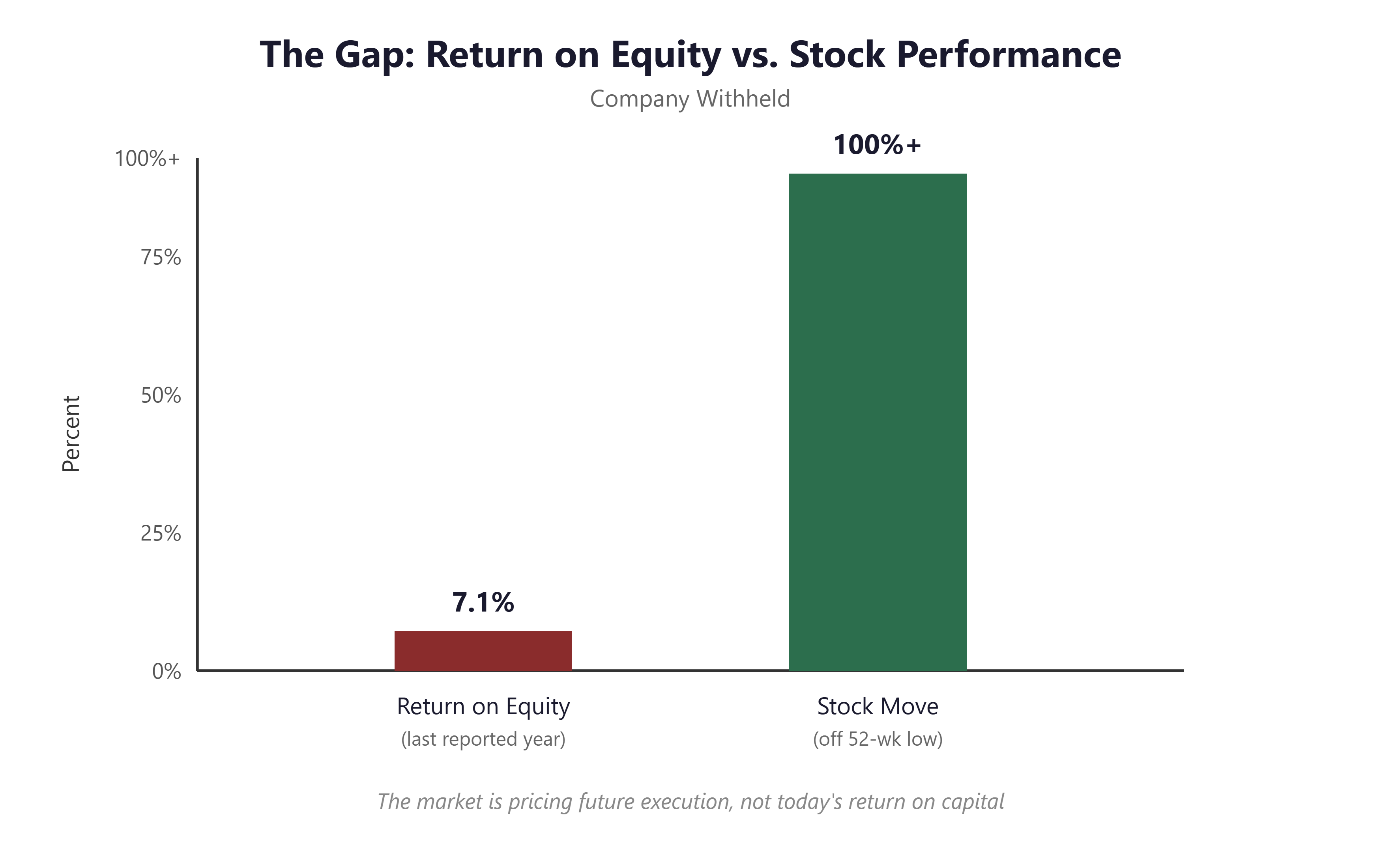
Here’s a genuinely odd pairing: a stock that has more than doubled off its 52-week low, trading at a market cap north of ₹25,000 crore, backed by a business whose reported return on equity sits at a modest 7%. Usually, a stock running that hot is riding a business that’s also compounding capital efficiently. Here, the market seems to be paying up for something else entirely: not today’s returns, but the size of what’s being built.
This is a capital-intensive infrastructure story, not a quality-compounder story, and understanding the difference is the whole point of this week’s case study.
What it does
This company builds, owns, and operates utility-scale renewable energy projects across India — solar, wind, hybrid, and a category called FDRE, firm and dispatchable renewable energy, which combines generation with storage to supply power on demand rather than only when the sun shines or the wind blows. It currently operates close to 2,900 MW of capacity, with another 14 projects under construction, spread across 12 states, and roughly half its capacity tied to central government-backed entities.
Revenue here doesn’t come from selling into a spot market. It comes from long-term, typically 25-year power purchase agreements signed with entities like SECI, NHPC, and SJVN — state-backed offtakers that lock in a fixed tariff for decades. That structure means revenue visibility is genuinely strong once a project is commissioned; the real risk sits earlier, in financing and building the project in the first place.
The company listed on the exchanges in November 2024, and has been aggressively scaling since, most recently securing over ₹3,400 crore in project financing from a public financial institution for a single 250 MW FDRE project.
Explanation video:
The numbers
Revenue for the trailing year came in at roughly ₹2,023 crore, with profit of about ₹498 crore. Return on equity, on a consolidated basis for the last full reported year, sits at just 7.1% — a figure that looks unremarkable next to the stock’s performance, and it’s worth understanding why that gap exists rather than ignoring it. This is a business in the middle of a heavy capital deployment phase: assets are being built and commissioned continuously, debt is being drawn down to fund construction, and a meaningful share of capacity is still ramping toward full operating revenue. Return on equity in a phase like this typically understates what a matured, fully-commissioned portfolio could eventually generate, but it also means today’s return is not the return you’re actually paying for.
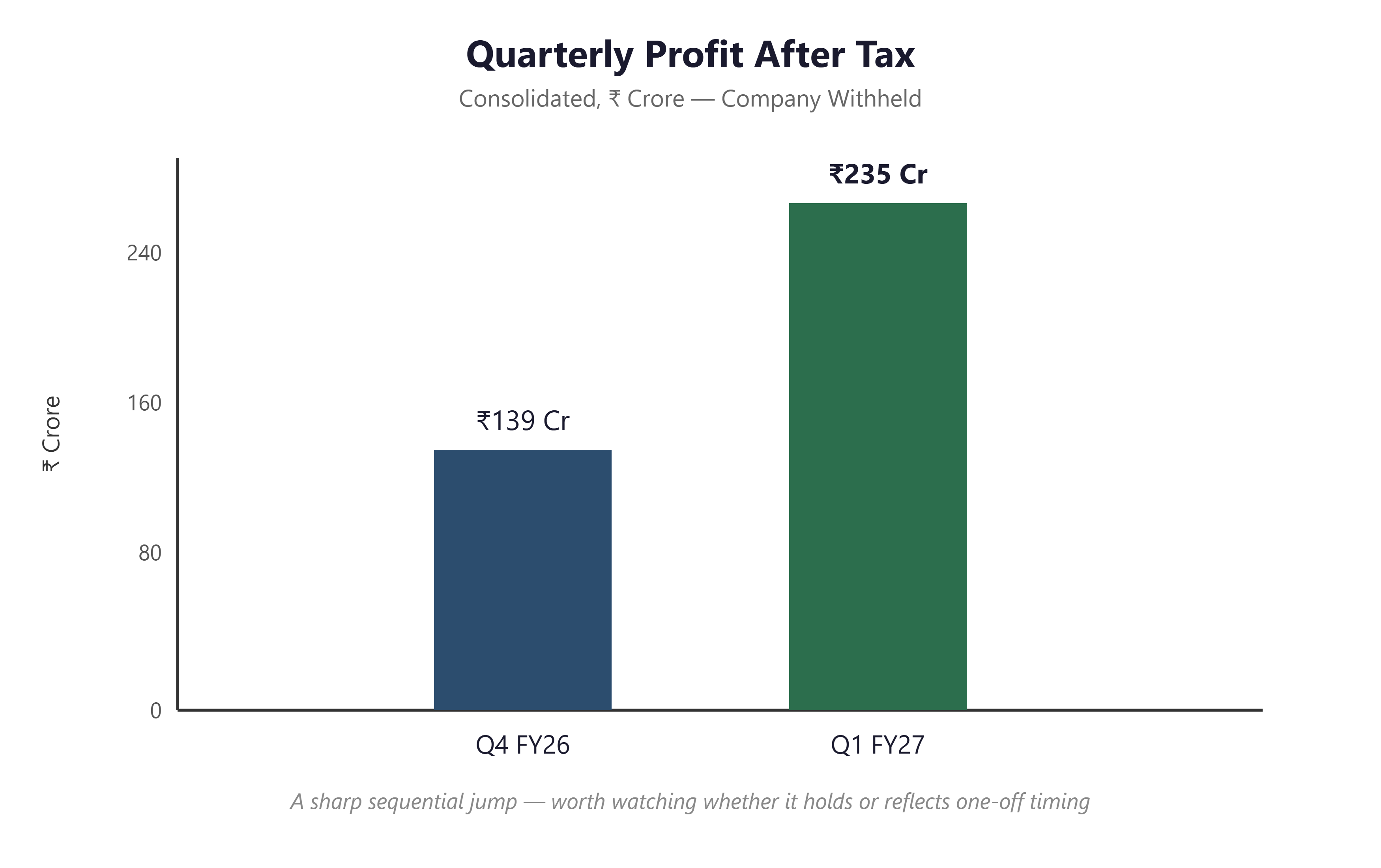
The most recent quarter showed a sharp jump: consolidated profit after tax came in at roughly ₹235 crore, up significantly from the prior quarter’s ₹139 crore, an acceleration worth watching for whether it holds or reflects one-off timing from newly commissioned capacity.
The stock itself has been genuinely volatile — a 52-week range of roughly ₹196 to ₹399 — and currently trades at a price-to-book multiple that has moved between roughly 3.3x and 4.4x depending on the exact date measured, alongside a price-to-earnings ratio that has climbed as high as the 50s to 70s as the stock has run up faster than reported profit. For comparison, listed renewable energy peers have recently traded at a median P/E closer to the low-20s, meaningfully below where this stock now sits.
Risks, plainly
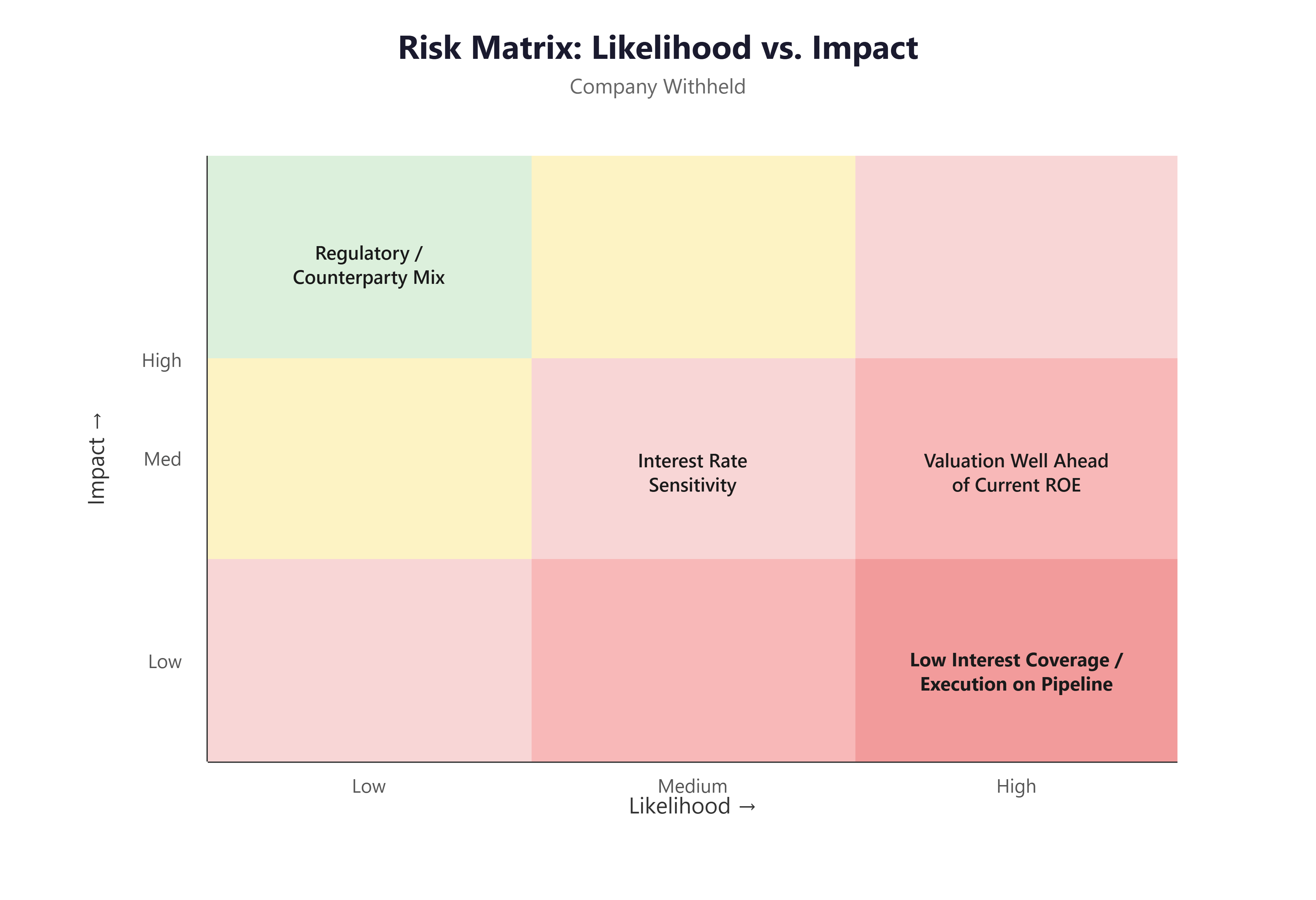
Low interest coverage ratio, flagged directly by independent data providers — a genuine concern for a business this leveraged, financing large, long-gestation projects with debt
Execution risk on the construction pipeline. Fourteen projects under construction need to be delivered on time and on budget for the growth story to actually show up in revenue and profit
A valuation that has run well ahead of current earnings and return on equity, pricing in successful execution and scaling rather than today’s actual returns
Interest rate sensitivity. As a heavily debt-funded infrastructure business, financing costs directly affect project economics and future profitability
Regulatory and counterparty concentration, given heavy reliance on a small number of large, state-backed offtakers and regulators for tariff approvals and power procurement
On valuation
At a market capitalization of roughly ₹25,800–25,900 crore, this stock is being priced as a growth story: the market appears to be underwriting successful delivery of the current construction pipeline and a meaningful step-up in return on equity as newer, larger projects mature, not the 7% ROE the business reports today. If execution goes to plan and the FDRE and hybrid pipeline scales as guided, today’s multiple may look reasonable in hindsight. If financing costs bite harder than expected, or project delivery slips, a valuation this far ahead of current fundamentals has real room to compress.
So — which company is it?
